If you’re here it means you like reading blogposts that I write. Check out my guest blogposts and the Mathematics Teacher site at NCTM for the next month or so. I’ll be trying to incorporate some of the advice and challenges I’ve faced in teaching with PBL and some of the ideas that I’ve shared with others.
Category: In the classroom
What is “Low Ability” Anyway? Comparing a Point to “Room”
One of my big “beefs” at my school is the fact that we have three levels of tracking – count ’em, three. There’s the honors track, that of course at a college prep school, most kids think they belong in. There’s the regular track, that which is still pretty quick and difficult, and there’s the track that the kids who are sometimes, I would say, just not very motivated to learn math, or have less interest in math, or maybe come from a school with a less rigorous math program, are placed in. These are the kids who probably all their lives have been told they are not “math people” and have been pigeon-holed as an “artist” or “writer” so they won’t actually need math when they get older. This really, really irks me. But I do it – I go along with a system that has been in place way before I got here. I’m only one person – even though I cite Jo Boaler’s list of research showing why “tracking” in general is just a bad idea and hurtful – I know I can’t win.
Anyway, I really shouldn’t complain because the department has let me do my thing with the geometry curriculum and I have written a PBL curriculum for the three levels. In my 201 book, I have created scaffolded problems that I think work really well with these “low-abiity” kids and often challenge them enough to make them realize how much ability they actually have. We just started talking about dimension and we watch these clips from Flatland: The Movie, where Arthur T. Square meets the King of Pointland and then meets the King of Lineland.
We had a great conversation about why the King of Pointland keeps saying “Hello Me, Hello Me” and can’t really understand why there’s anyone else there. We talked about why the King of Lineland doesn’t understand where the Square is because he only understands the directions of left and right. One of the kids goes, “Is this kind of like what happened in the movie Interstellar? I think he went through a black hole and just appeared in the future or something.” Now, I hadn’t seen that movie but then another kid said, “Well, I’m not sure it was like that.” But then one of the other students says, “No, the King of Pointland is kind of like the kid in the movie Room. Did you see that movie?” I nodded in understanding and so did many of the others in class. The student went on, “In Room, the little boy grew up thinking that “Room” was his whole universe so that was all he understood, and that’s why the King of Pointland seems so nuts. That point with no dimensions is all he can understand – there’s no one else in the world.” I was so blown away by that analogy. She really had an understanding of the idea of the limitations of being alone in the universe of a point. I had never had a kid in a “regular” or “honors” class make a connection like that – but then again, Room just came out!
Repost: Always Striving for the Perfect Pose
Back in 2010, I wrote an blogpost comparing teaching with PBL to doing yoga. Since I have been doing Bikram Yoga for almost a year now and still can’t do “standing head to knee pose” *at all* – I thought I would repost this one just to give myself some perspective, and possibly many of you out there who might need a little encouragement at this beginning of the year time. I know that every year when students begin a year in a PBL math class the obstacles return. Parents are questioning “why isn’t the teacher teaching?” Students are questioning “why is my homework taking so long?” Teachers new to the practice are questioning “When is this going to get easier?” and “why aren’t they seeing why this is good for them like I do?” The best thing to remember is that it is a process and to understand how truly different and hard it is for students who are used to a very traditional way of learning mathematics. Give them time, have patience for them and yourself and most of all reiterate all of what you value in their work – making mistakes, taking risks, their ideas (good and bad) and be true to the pedagogy.
Here’s the original blogpost I wrote:
I don’t think my professor, Carol Rodgers, would mind me borrowing her yoga metaphor and adapting it to PBL. I use it often when talking to teachers who are nervous about falling short of their ideal classroom situation or teaching behaviors. I think this can happen often, especially when learning best practices for a new technique like facilitating PBL. There are so many things to remember to try to practice at your best. Be cognizant of how much time you are talking, try to scaffold instead of tell, encourage student to student interaction, turn the questions back onto the students, etc. It really can be a bit overwhelming to expect yourself to live up to the ideal PBL facilitator.
However, it is at these times that I turn to Carol’s yoga metaphor. She says that in the practice of yoga there are all of these ideal poses that you are supposed to be able to attain. You strive to get your arms, legs and back in just the right position, just the right breathing rhythm, just the right posture. But in reality, that’s what you’re really doing – just trying. The ideal is this goal that you’re aiming for. Just like our ideal classroom. I go in everyday with the picture in my head of what I would want to happen – have the students construct the knowledge as a social community without hierarchy in the authority where everyone’s voice is heard. Does that happen for me every day? Heck no. I move the conversation in that direction, I do everything in my power for that to happen, but sometimes those poses just don’t come. Maybe I just wasn’t flexible enough that day, or maybe the students weren’t flexible enough, maybe we didn’t warm up enough, or the breathing wasn’t right. It just wasn’t meant to be. I have exercises to help me attain the goal and I get closer with experience. That’s all I can hope for.
So I tell my colleagues who are just starting out – give yourself a break, be happy for the days you do a nearly perfect downward facing dog, but be kind to yourself on the days when you just fall on your butt from tree pose. We are all just trying to reach that ideal, and we keep it in mind all the time.
Journals: Paper vs Digital: The Pros and Cons
I was totally honored the other day when I saw some tweets from TMC16 from @0mod3 and @Borschtwithanna
Love the shout outs to @SchettinoPBL in @Borschtwithanna journal session! (And in my session!) #TMC16
— Danielle Reycer (@0mod3) July 17, 2016
@SchettinoPBL @0mod3 The only reason I started doing writing with my students is from a talk you gave ~ 10 years ago (!!)
— Anna Blinstein (@Borschtwithanna) July 17, 2016
And yes it’s true, I’ve been writing and practicing the use of metacognitive journaling for very long time – probably since 1996 ever since I read Joan Countryman’s book about mathematical journaling and heard about it in many workshops that summer. I wrote a rubric (make sure you scroll to the 3rd page) while I was at the Klingenstein Summer Institute for New Teachers (that’s how long ago it was) and since then I’ve been refining that rubric based on feedback from students and teachers. A few years ago, I finally refined a document called How to Keep a Journal for Math Class to a degree that I really like it now. However, please know that lots of math teachers do journaling differently and without the metacognitive twist. I do believe that metacognitive writing is essential to the PBL classroom (read more here)
So this morning, I was asked this question on twitter
Thoughts on paper vs electronic journals in math class? @SchettinoPBL @MathMinds I teach 9th grade and we are 1-1 with chromebooks
— Kathryn Freed (@kathrynfreed) July 23, 2016
Which is something that many people often ask so I thought I’d respond with a more in-depth answer.
Here are the pros, I’ve found over the years of having students journal digitally:
Speed/complexity: Students are used to typing, using spell-check, inserting pictures, graphics and naturally including documents, links and thinking in the complex way that digital media allows them to. It allows their journal to be more rich in content and sometimes connect problems to each other if their journal is say on a google doc that can connect to other html docs. If they create, for example, iBooks or Explain Everything videos, there is even a lot more richness that can be embedded in the file as well – their creativity is endless.
Grading/Feedback: I found grading in Notability or on Google docs or some other digital platform really nice that allowed you to add comments with a click or audio extremely easy and quick. I did not receive feedback from the students very often about how the feedback helped them though. If you use an LMS like Canvas that integrates a rubric or integrates connection to Google it’s even nicer because you can have those grades go right from your assignment book to your gradebook.
I love having kids use digital platforms for writing/creating in mathematics when it is for a project or big problem that I want them to include many pieces of evidence, graphs, geogebra files and put it together nicely in a presentation or portfolio. Not necessarily for their biweekly journals. Some guys who make use of digital journals in interesting ways are @GibsonEdu and @FrasiermathPBL at the Khabele School in Austin TX.
Here are the cons, in my mind of using digital journals: (which might be the “pros” of paper journals) – which is the side I have come down on.
the “real” writing factor: there is some research about the actual physical process of writing and the time it takes for kids to process their thoughts. I do believe that when i want kids to be metacognitive about their learning and also want them to be thoughtful and take the time think about their initial error, think about what happened in class discussion to clear up their misunderstanding and also then what new understanding they came to. That’s a lot of thinking. So I want them to take the time to write all that down. Sometimes typing (like what I’m doing right now!) is a fast process and I’m not sure I do my best writing this way.
practice in hand-writing problem solving: this is re-enacting doing homework and sitting for assessments (in my class at least) and I want them to do this more regularly. If in your class kids take assessments digitally or do homework nightly digitally then maybe they should do their journal digitally as well. This also give me practice in reading their handwriting, getting to hear their voice through their handwriting and seeing what it looks like on a regular basis. In a time crunch on an assessment it honestly helps me know what they are thinking.
Conversational Feedback: I feel that when I hand write my feedback to them I can draw a smilely face or arrows or circle something that I want to emphasize more easily than when it is on something digitally (this is also true in a digital ink program – so that is something to consider, like Notability for example). I give feedback (see some journal examples on my blog) that is very specific about their writing and want the to improve not only in the math aspect of their writing but in how they are looking at their learning. I want them to respond and I want to respond in the hope that we are starting a mathematical conversation about the problem. I have received more questions about the feedback in the paper journals (like “what did you mean by this?”) than on the electronic feedback – not sure why.
Portability: I find that small composition graph paper notebook is extremely portable and easy for me to carry home to grade. The students bring them to their assessments and there is nothing else in the notebook (no homework at all and no access to the internet) so I am not worried about academic honestly.
There are probably more but this is it in a nutshell – please add your comments below or tweet me to let me know your thoughts!
Adventures in Feedback Assessment
On an assessment students did for me today I gave this question:
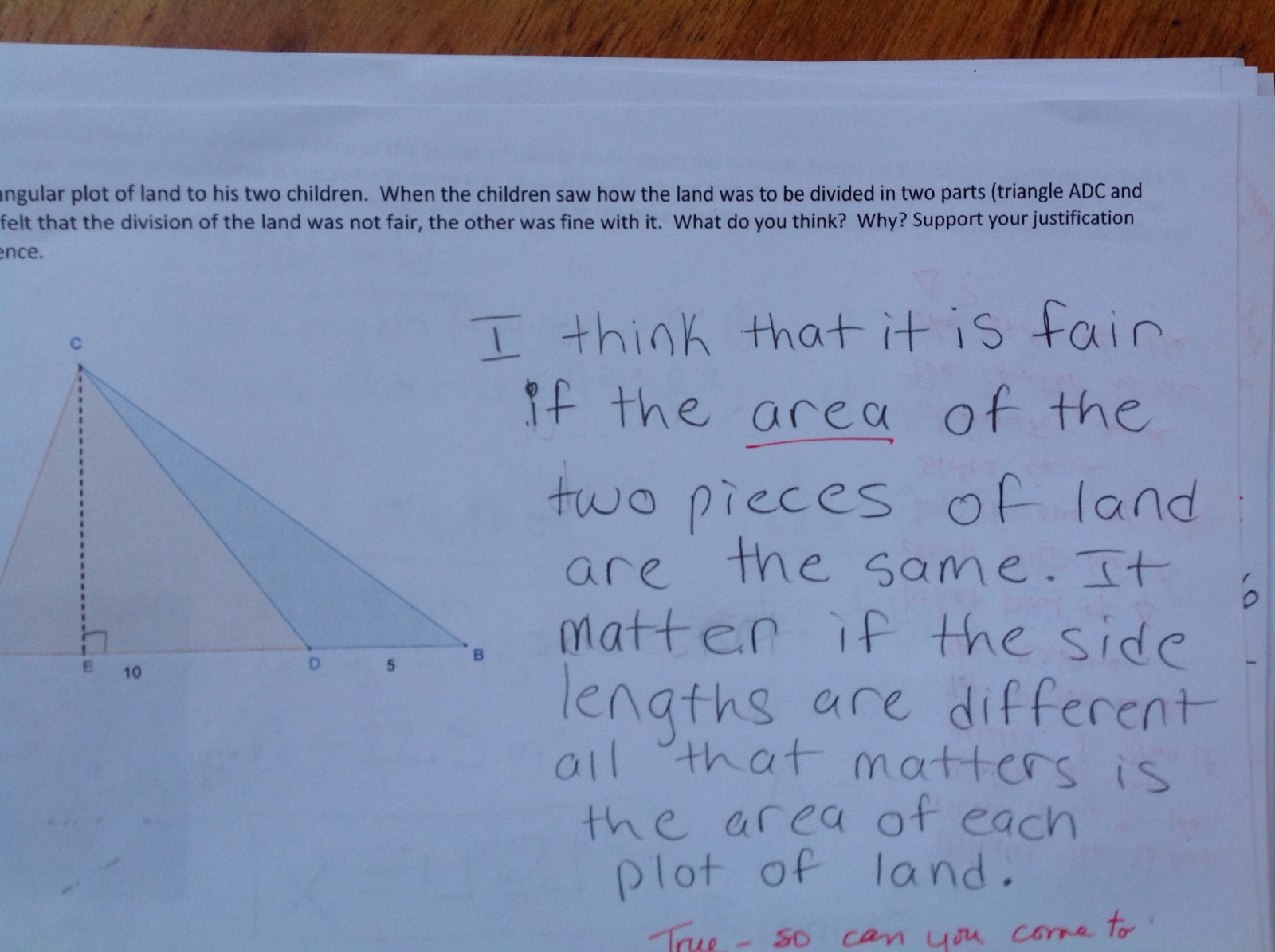
An aging father left a triangular plot of land to his two children. When the children saw how the land was to be divided in two parts (Triangle ADC and Triangle BDC), one child felt that the division of the land was not fair, while the other was fine with it. What do you think and why? Support your justification with mathematical evidence.
The area of the shaded triangle is 15. Find the area of the unshaded triangle.
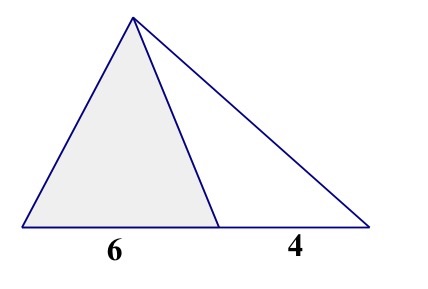
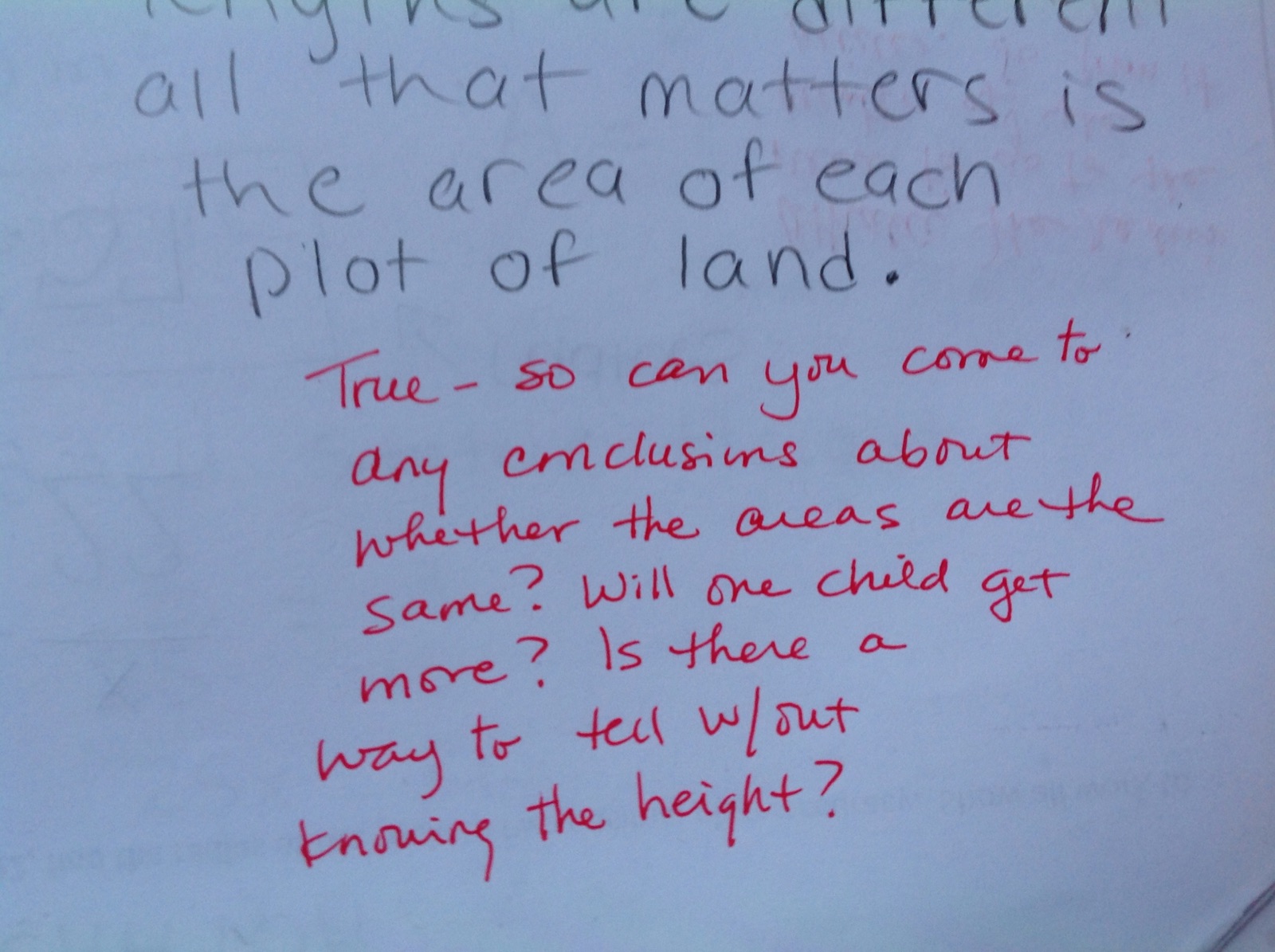
This idea of where the height of obtuse triangles are is a really tough one for some geometry students. But more than that the idea of sharing a height and what effect that has on the area is also difficult.
We will see tomorrow if this student is able to take my feedback and see what whether the division of the land is fair.
By the way, here’s a response that another student had:

Just in case you can’t read it:
“Because the height is the same, it’s the ratio of the bases that would determine which child would get the most land. I think the division of land was not fair, because the heights are the same so therefore the bases are determining the area of the plot. If x=5 then child one would get A=20, child 2 would get 12.5 and that makes the original plot of land 37.5. This means child 2 has a third of the land (12.5:25) (part:part) and half of child 1’s) Even without x=5, the child 2 would only get a third of the land.”
We’ll see what happens!
Getting Kids to Drive the Learning
It doesn’t always work this way, but it would be awesome if it did. When PBL is perfect or ideal, the students are the ones who make the natural connections or at least see the need or motivation for the problems that we are doing. Yeah, some of them are just really interesting problems and the get pulled in by their own curiosity, but as all math teachers know, we have a responsibility to make sure that students learn a certain amount of topics, it is quite that simple. If students from my geometry class are going into an algebra II class with trigonometry the next year where their teacher will expect them to know certain topics, I better do my job and make sure they have learned it.
So how do I, as a PBL teacher, foster the values for the problem-based learning that I have while at the same being true to the curriculum that I know I have a responsibility to? This is probably one of the biggest dilemmas I face on a daily basis. Where’s the balance between the time that I can spend allowing the students to struggle, explore, enjoy, move through difficulty, etc. – all that stuff that I know is good for them – while at the same being sure that that darn “coverage” is also happening?
So here’s a little story – I have a colleague sitting in on my classes just to see how I teach – because he is interested in creating an atmosphere like I have in my classes in his. We have just introduced and worked on problems relating to the tangent function in right triangle trigonometry in the past week and now it was time to introduce inverse tangent. I do this with a problem from our curriculum that hopefully allows students to realize that the tangent function only is useful when you know the angle.
So as students realize they can’t get the angle from their calculator nor can they get it exactly from the measurement on their protractor (students had values ranging from 35 to 38 degrees when we compared), one of the students in my class says, “Ms. Schettino, wouldn’t it be great if there was a way to undo the tangent?” and the other kids are kind of interested in what she said. She continues, “Yeah, like if the calculator could just give us the angle if we put in the slope. That’s what we want.” I stood there in amazement because that was exactly what I wanted someone to crave or see the need for. It was one of those “holy crap, this is working” moments where you can see that the kids are taking over the learning. I turned to the kids and just said, “yeah, that would be awesome, wouldn’t it? Why don’t you keep working on the next problem?” and that had them try to figure out what the inverse tangent button did on their calculator. They ended up pressing this magical button and taking inverse tangent of 0.75 (without telling them why they were using 0.75 from the previous problem) to see if they could recognize the connection between what they had just done and what they were doing.
At the end of the class, the colleague who was observing came up to me and said, “How did you do that?” and I said, “What do you mean?” and he said, “How did you get the kids to want to learn about inverse tangent? I mean they just fell right into the thing you wanted them to learn about. That was crazy.” I really had to think about that. I didn’t feel like I did anything honestly, the kids did it all. I mean what made them all of a sudden care about getting the angle? Why were they invested? It doesn’t always happen in my classroom that’s for sure. This is not a perfect science – there’s no recipe for it to work – take a great curriculum, interested kids, an open, respectful learning environment and mix well?
I do think however that a huge part of it is the culture that has been created throughout the year and the investment that they have made in their ownership and authorship in their own learning. We have valued their ideas so much that they have come to realize that it is their ideas and not mine that can end up driving the learning – and yes, I do end up feeling a little guilty because I do have a plan. I do have something that I want them to learn, but somehow have created enough interest, excitement and curiosity that they feel like they did it. It is pretty crazy.
Revisiting Journals: Getting Kids to Look Back
I have been using metacognitive journaling in my PBL classroom since 1995. I first learned about it the Summer Klingenstein Institute when I was a third year teacher and just fell in love with it. At that time, the colleagues at my school thought I was crazy trying to make kids write in my classes – it was just “something else for them to do” and didn’t really help them learn but I did more reading on it and there was clearly more and more research as time went on that showed that writing-to-learn programs especially those that prompt for metacognitive skills really do help in learning mathematics (see my metacognitive journaling link under the Research tab for more info and sample journal entries).
Every once in a while a student will write a journal entry that I think is so thoughtful that I will write about it like this one a few years ago that just impressed me with his insight into his learning process of a particular problem. But other times kids write about their understanding of their learning overall like one I’ll write about today and I am also blown away.
Here’s a student I’ll call Meaghan reflecting on a problem that she found challenging for her. Really, it doesn’t matter which problem it was or what topic it was, just the fact that she had a hard time with it at first, right? The most important part was that after she wrote about how to do it correctly, she then took the time to write this: (in case you can’t read her handwriting, I will rewrite it below).
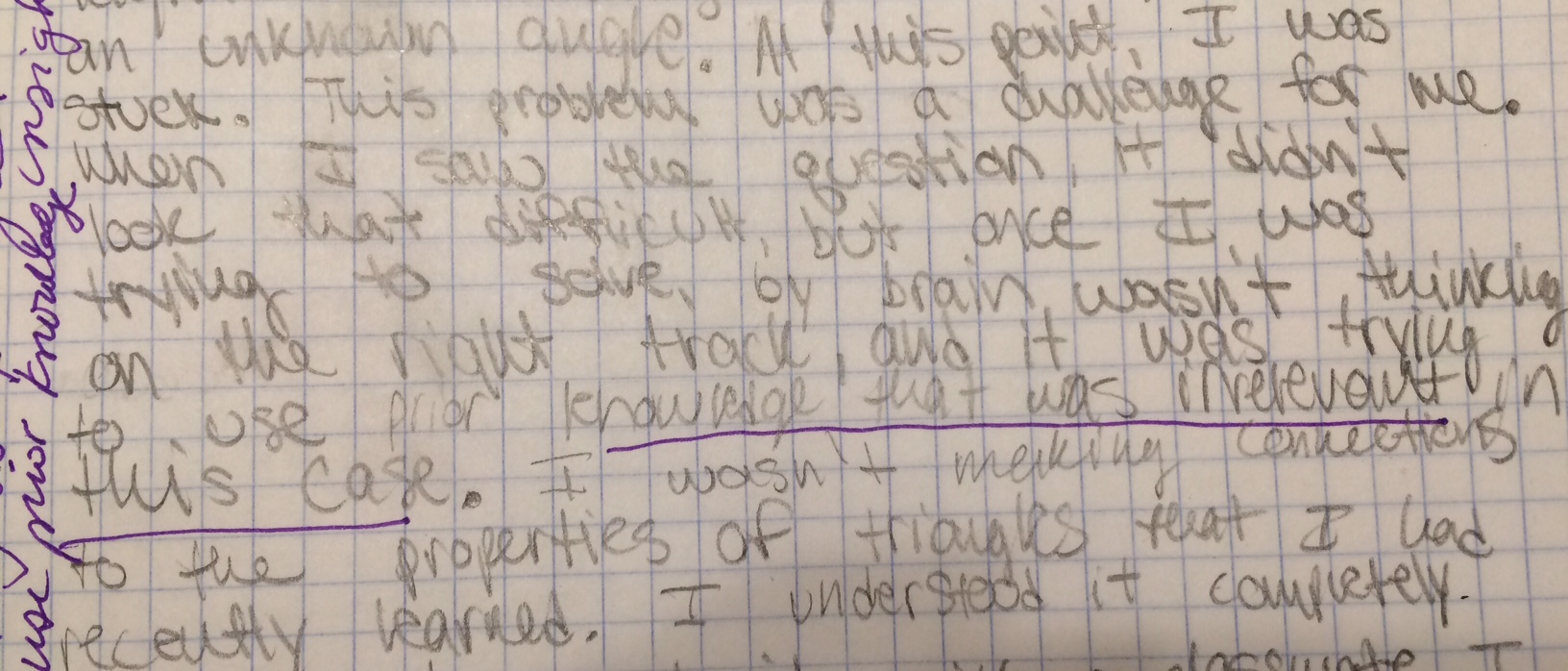
“This problem was a challenge for me. When I saw the question, it didn’t look that difficult but once I was trying to solve by [sic my] brain wasn’t thinking on the right track, and it was trying to use prior knowledge that was irrelevant in this case. I wasn’t making connections to the properties of triangles that I had recently learned.”
Why is this realization so important for Meaghan? Polya’s Fourth Principle of Problem Solving is “Look Back” – why is this fourth principle so important? In my mind, this is where all the learning happens. The three other principles are very clear
- Understand the problem
- Device a plan
- Carry out the plan
These three are all very basic – if they work, right? But most of the time they don’t work for kids. It’s the fourth step that we know is the most important – it’s where the critical thinking and analysis takes place. If this part isn’t taken seriously and the right steps within it are not taken nothing happens, no moving forward, no growth.
So what did Meaghan do? She realized that she had not made a connection between the triangle properties that we had just learned and how it applied to this problem. She had not use the correct prior knowledge. She just created more openings to other knowledge that she knows- and I know what you’re thinking. Does this mean that next time she will use the correct prior knowledge in another problem? From my experience with kids, no, it does not. But honestly, what I have seen is that the more they realize that there are more possibilities and also that the option of just saying “I don’t get it” or “I can’t do this” is unlikely, the more they will keep trying.
So what did Meaghan do? By just being asked to write a reflection about one problem (every two weeks) she has reinforced her own potential in problem solving on HER OWN. That she may, in the future, weed out the irrelevant prior knowledge and possibly see the connections to the relevant prior knowledge, with more practice. I think it’s made her feel just a little bit more confident – and they said it was just “something else for them to do.”
Everything Old is New Again…(or why teaching with PBL is so great)
So I heard that what everyone is saying about the new Star Wars Movie, The Force Awakens, is that “Everything Old is New Again” – go ahead google it, there are at least 5 or 6 blog posts or articles about how “BB-8 is the new R2D2” or “Jakku is the new Tattoine” or whatever. I actually don’t have a problem with J.J. Abrams reusing old themes, character tropes or storylines because I think that really great stories are timeless and have meaning and lessons that surpass the movie that you are watching. I still thought it was awesome.
This concept of everything old is new again really hit home to me today in my first period class when I was having the students do a classic problem that I probably first did in 1996 while I was under the tutelage of my own Yoda, Rick Parris (who I think wrote the problem, but if someone reading this knows differently, please let me know). The problem goes like this:
Pat and Chris were out in their rowboat one day and Chris spied a water lily. Knowing that Pat liked a mathematical challenge, Chris announced that, with the help of the plant, it was possible to calculate the depth of the water under the boat. When pulled taut, directly over its root, the top of the plant was originally 10 inches above the water surface. While Pat held the top of the plat, which remained rooted to the lake bottom, Chris gently rowed the boat five feet. This forced Pat’s hand to the water surface. Use this information to calculate the depth of the water.
What I usually do is have students get into groups and put them at the board and just let them go at it. Today was no exception – the first day back from winter break and they were tired and not really into it. At first they didn’t really know what to draw, how to go about making a diagram but slowly and surely they came up with some good pictures. Some of the common initial errors is not adjusting the units or mislabeling the lengths. However, one of the toughest things for students to see eventually is that the length of the root is the depth of the water (let’s call it x) plus the ten inches outside of the water’s surface. Most students end up solving this problem with the Pythagorean Theorem – I’ve been seeing it for almost 20 years done this way. Although I never tire of the excitement they get in their eyes when they realize that the hypotenuse is x+10 and the leg is x.
However, since everything old is new again, today I had a student who actually is usually a rather quiet kid in class, not confused, just quiet, but in a group of three students he had put his diagram on a coordinate plane instead of just drawing a diagram like everyone else did. This intrigued me. He initially wrote an equation on the board like so:
y= 1/6 (x – 0)+10
and I came over and asked him about it. He was telling me that he was trying to write the equation of one of the sides of the triangle and then I asked him how that was going to help to find the depth of the water. He thought about that for a while and looked at his partners. They didn’t seem to have any ideas for him or were actually following why he was writing equations at all. He immediately said something like, “Wait, I have another idea.” and proceeded to talk to his group about this:
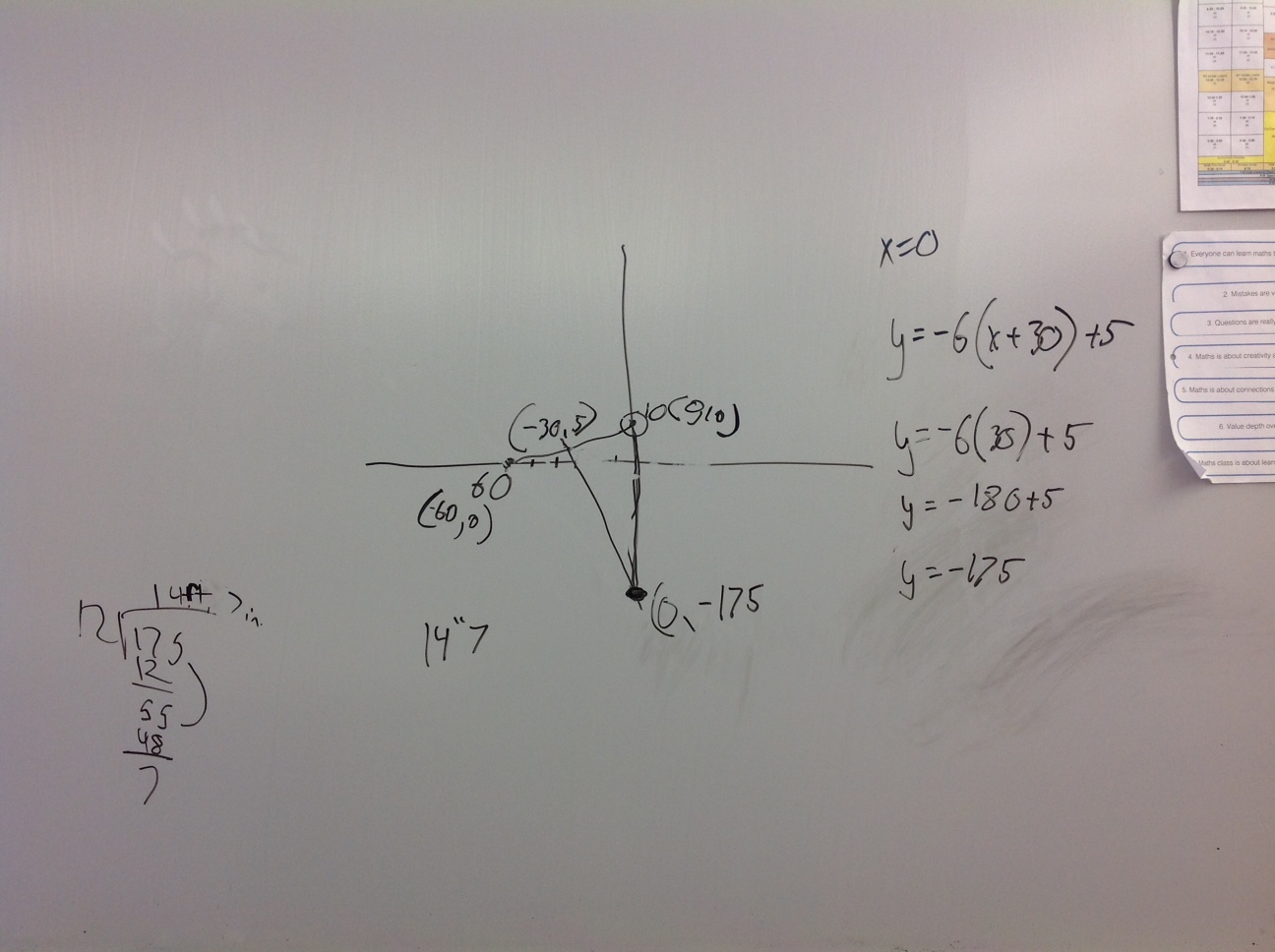
He had realized from his diagram that the two sides of the triangle would be equal and that if we wrote the equation of the perpendicular bisector of the base of the isosceles triangle and found its y-intercept he would find the depth of the water. He proceeded to find the midpoint of the base, then the slope of the base, took the opposite reciprocal and then evaluated the line at x=0 to find the y-intercept. I was pretty impressed – I had never seen a student take this perspective on this problem before.
This made my whole day – I was really dreading going back to work after vacation and honestly, first period was the best class of the day when this wonderful, new method was shown to me and this great experience of this student’s persistence refreshed my hope and interest in this problem. Perpendicular bisectors are the new Pythagorean Theorem!
Someday I’ll get this assessment thing right… (Part 2 of giving feedback before grades)
So, all assessments are back to the students, tears have been dried and we are now onto our next problem set (what we are calling these assessments). What we’ve learned is that the rubric allowed us to easily see when a student had good conceptual understanding but perhaps lower skill levels (what we are used to calling “careless mistakes” or worse). We could also quickly see which problems many students had issue with once we compared the rubrics because, for example, problem number 6 was showing up quite often in the 1 row of the conceptual column. This information was really valuable to us. However, one thing we didn’t do was take pictures of all of this information to see if we could have a record of the student growth over the whole year. Perhaps an electronic method of grading – a shared google sheet for each student or something to that effect might be helpful in the future – but not this day (as Aragorn says) – way too much going on right now.
We also changed the rubric a bit for a few reasons. First, we found that when students completed the problem to our expectations on the initial attempt we felt that they should just receive 3’s for the other two categories automatically. We considered not scoring them in this category but numerically felt that it was actually putting students who correctly completed a problem at a disadvantage (giving them fewer overall points in the end). Second, we also changed the idea that if you did not write anything on the revisions you earned 0 points for the revisions columns. Many students told me afterwards that they felt like they just ran out of time on the revisions and actually had read the feedback. This was unfortunate to me since we had spent so long writing up the feedback in the hope that the learning experience would continue while doing revisions.
Here is the new version of the rubric: Revised Problem Set Grading Rubric new
What we decided to do was to try the revisions this time without the “explanation” part of writing. I think it will keep the students focused on reading the comments and attempting a new solution. I was frankly surprised at how many students stuck to the honor pledge and really did not talk to each other (as they still got the problem wrong the second time around – with feedback). Truly impressive self-control from the students in my classes and how they were sincerely trying to use the experience as a learning opportunity.
I do think the second assessment will go more smoothly as I am better at doing the feedback and the rubric grading. The students are now familiar with what we are looking for and how we will count the revisions and their work during that time. Overall, I am excited about the response we’ve received from the kids and hope that this second time is a little less time-consuming. If not, maybe I’ll just pull my hair out but I’ll probably keep doing this!
Why Teachers Don’t Give Feedback instead of Grades, and Why We Should
First in a series of posts about my experiences with “Feedback Before Grades”
Holy Mackerel is all I have to say – Ok, well, no I have plenty more to say – but after about a week and a half of holing myself up with my colleague, Kristen McVaugh, (big shout-out to Ms McVaugh who is not only teaching PBL for the first time but was willing to dive into this amazing journey of alternative assessment with me this year too), I am totally exhausted, almost blind as a bat, partially jaded and crazy – but mostly ready for a drink. This little looped video of Nathaniel Rateliff and the Night Sweats pretty much sums it up…
So here was our well-intentioned plan: we wanted to start the year off with a different type of assessment. I put out my feelers on twitter and asked around if anyone had a rubric for grading assessments where the teacher first gave only feedback and then allowed students to do revisions and then once the revisions were done the students received a grade. Kristen and I knew a few things:
- we wanted to make sure the revisions were done in class
- we wanted to make sure the revisions were the students’ own work (tough one)
- we wanted to give students feedback that they needed to interpret as helpful so that we weren’t giving them the answer – so that it was still assessing their knowledge the second time around
- we wanted to make sure that students were actually learning during the assessment
- we wanted students to view the assessment as a learning experience
- we wanted students to be rewarded for both conceptual knowledge and their skills in the problem solving too
So we created this rubric Initial Draft of Rubric for Grading. It allowed us to look at the initial conceptual understanding the student came to the problem set with and also the initial skill level. Kristen and I spent hours and hours writing feedback on the students’ papers regarding their errors, good work and what revisions needed to be done in a back-handed sort of way.
Here are some examples:
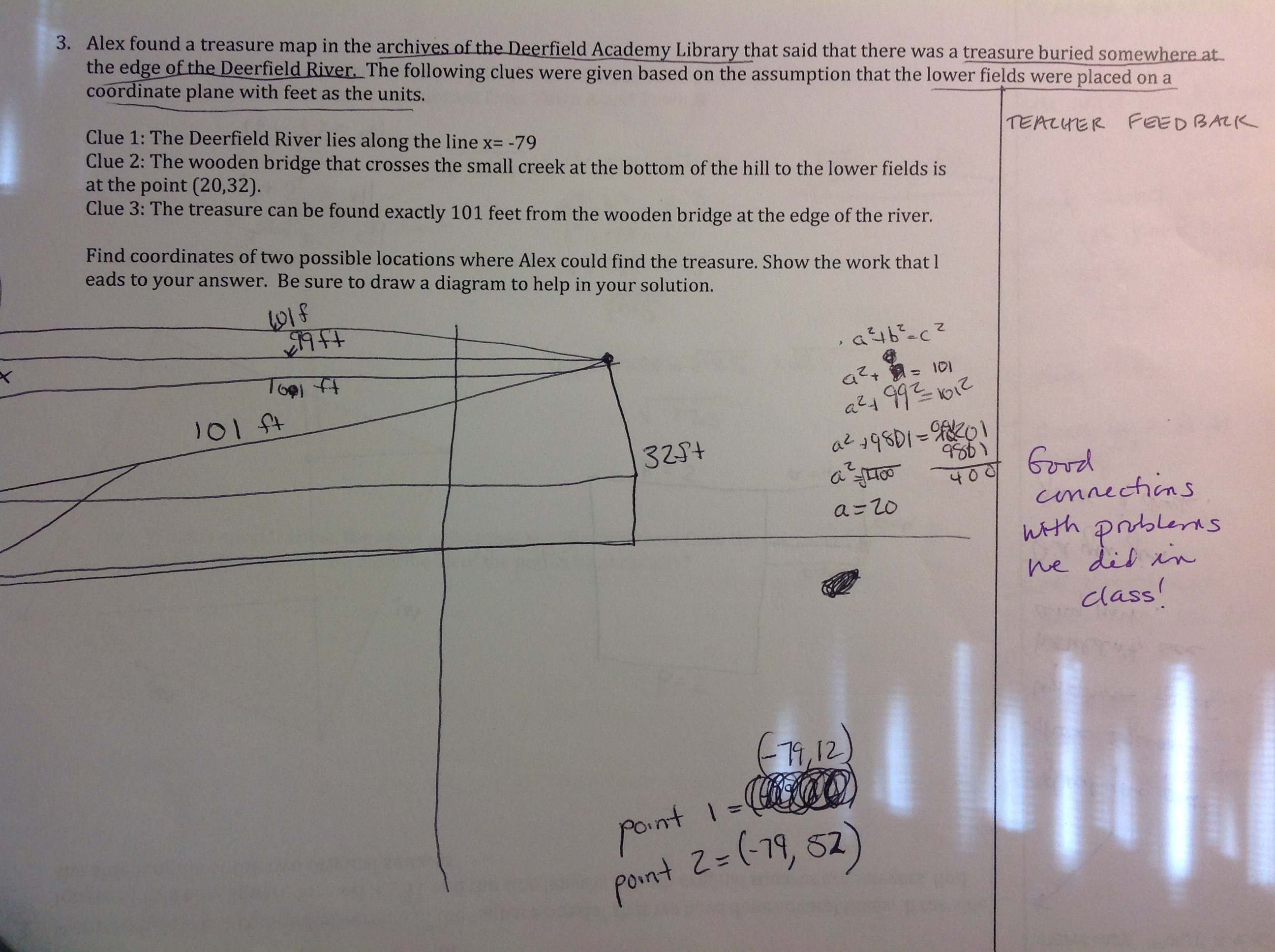
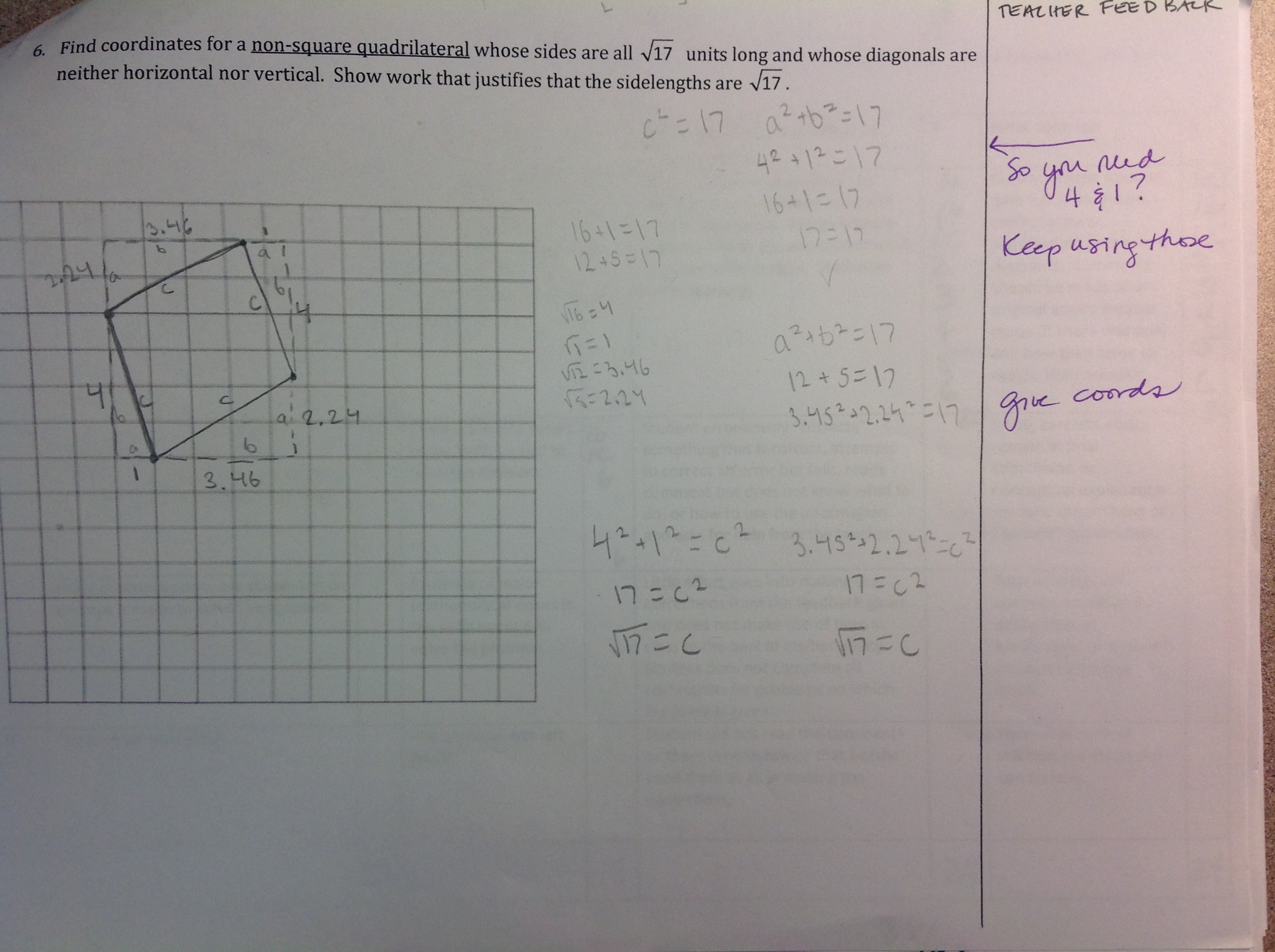
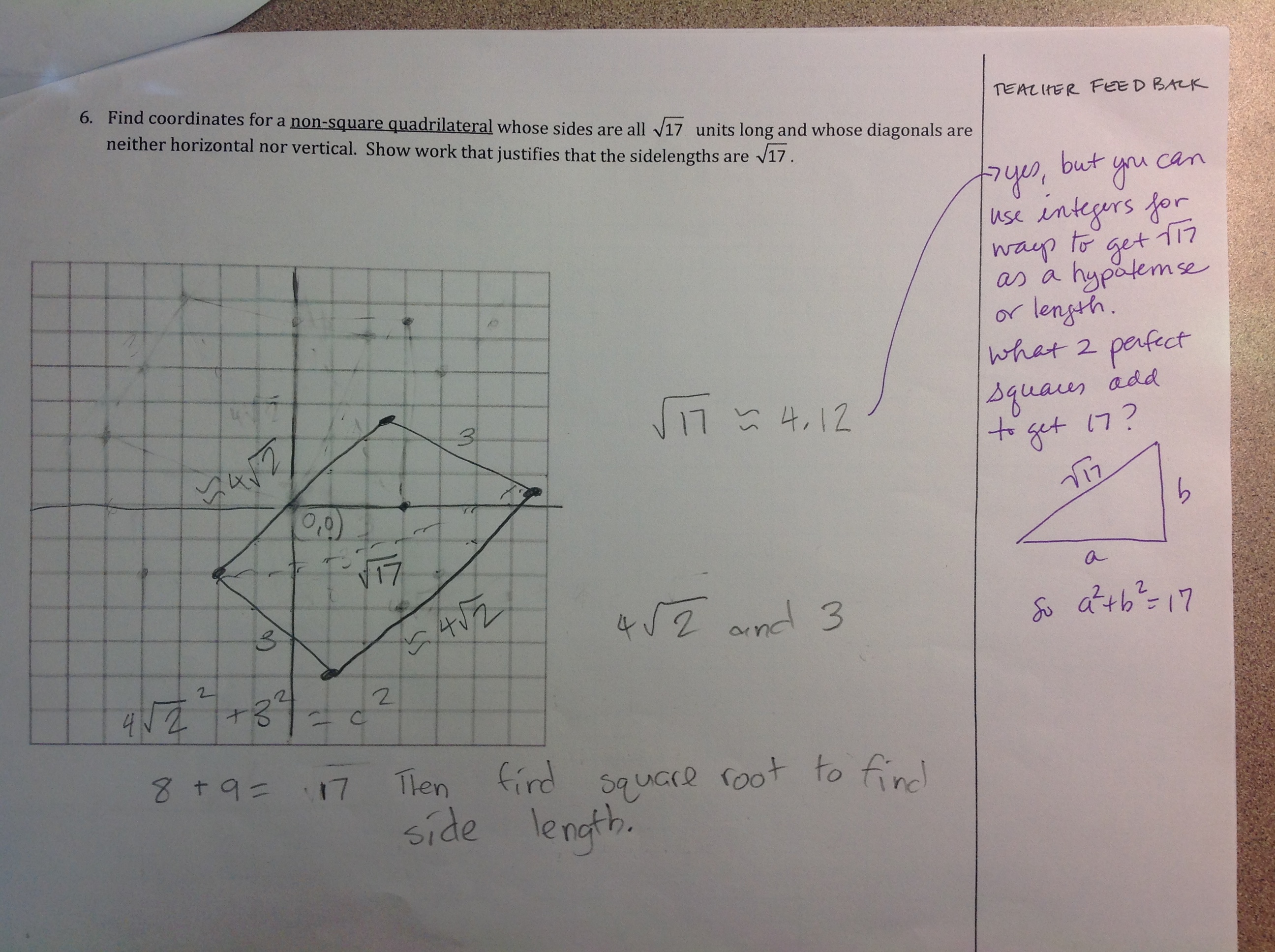
Some kids’ work warranted more writing and some warranted less. Of course if it was wonderful we just wrote something like, excellent work and perhaps wrote and extension question. The hard part was filling out the rubric. So for example, I’ll take Student 3’s work on problem 6 which is the last one above. Here is the rubric filled out for him:

You will notice that I put problem 6 as a 1 for conceptual understanding and a 2 for skill level (in purple). In this problem students were asked to find a non-square quadrilateral with side lengths of sqrt(17). Student 3 was definitely able to find vertices of a quadrilateral, but he was unable to use the PT to find common lengths of sides. I gave him feedback that looking at sqrt(17) as a hypotenuse of a right triangle (as we had done in class) would help a bit and even wrote the PT with 17 as the hypotenuse in the hope of stimulating his memory when he did the revisions.
The day of the revisions Student 3 was only capable of producing this:
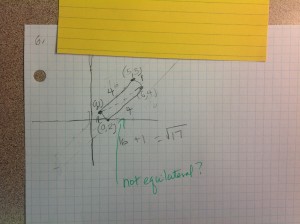
He followed my direction and used 4 and 1 (which are two integers that give a hypotenuse of 17, but did not complete the problem by getting all side lengths the same. In fact, conceptually he kind of missed the boat on the fact that the sqrt(17) was supposed to be the side of the quadrilateral altogether.
One success story was Student 2. She also did this problem incorrectly at first by realizing that you could use 4 and 1 as the sides of a right triangle with sqrt(17) as the hypotenuse but never found the coordinates of the vertices for me. I gave her feedback saying there might be an easier way to do this because she needed vertices. However, she was able to produce this:
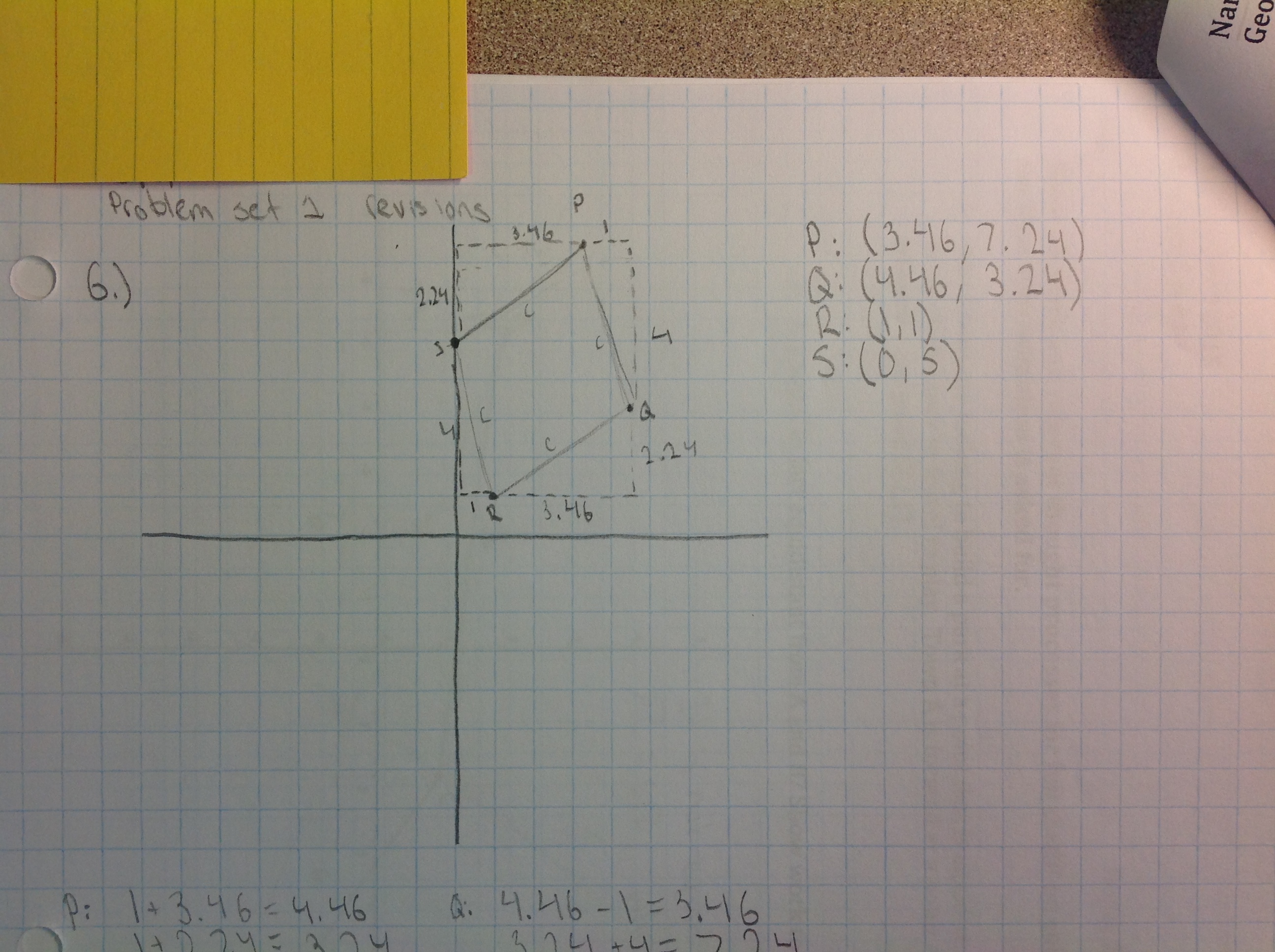
Although she did not give me integer-valued coordinates (which was not required) and she approximated which officially would not really give sqrt(17) lengths it came pretty darn close! I was impressed with the ingenuity and risk-taking that she used and the conceptual knowledge plus the skill-level. Yes, most other kids just used some combination of 1’s and 4’s all the way around but she followed her own thought pattern and did it this way. Kudos to student 2 in my book.
Next time I will talk about some of the lessons we learned, other artifacts from the kids’ work and what we are changing for next time! Oh yeah and some great martini recipes!