Spring has Sprung – and so has the French Garden!

So the spring term means two things for my Honors Geometry kids – the technology inquiry project and looking at the French Garden Problem.  So for those of you who are not familiar with both of those I’ll try to quickly fill you in while I talk about how they just happen to so coolly (is that an adverb?  if not I just made it up) overlapped this week.

My Spring Term Technology Inquiry Project is something I came up with three years ago when I really wanted a way to push my honors geometry students into thinking originally while at the same time assessing their knowledge of using technology.  I did a presentation last year at the Anja S. Greer Conference on Math, Science and Technology and the audience loved it.  Basically, I give students an inquiry question (one that I attribute to my good friend Tom Reardon) that they have to work on with technology and then they have to come up with their own inquiry question (which is, of course, the fun part) and explore that with technology and/or any other methods they wish.  I have received some pretty awesome projects in the past two years and I don’t think I am going to be disappointed this year either.

The French Gardener Problem is famously used in my PBL courses at the MST Conference as well.  Everyone who has taken my course knows the fun and interesting conversations we have had about the many ways to solve it and the extensions that have been created by many of my friends – an ongoing conversation exists somewhere in the Blogosphere about the numerous solutions – In fact Tom sent me a link just last fall to a more technological solution at Chris Harrow’s blog. (We’re such geeks).  Great math people like Phillip Mallinson and Ron Lancaster have also been drawn in by the attractive guile of the The French Gardener Problem.  In this problem, the main question is what fraction of the area of the whole square is the octagon that is formed inside (what is the patio for the garden)?

So the other night, after we had worked on this question in class for a couple of days and the students had meet with me in order for me to approve their original inquiry question, a student stops by to discuss his question.  John starts off with, “I can’t think of anything really. What I had wanted to do, someone else already claimed.” (I’m not letting them do a question that someone else has already decided to look into.  So John sits in my study and thinks for a while. I told him that this part of the project was supposed to be the fun part.  I gave him some thoughts about extending some problems that he liked.  He said he had liked the French Garden Problem and thought it was really cool.  So I went back to some of my work and he started playing with GeoGebra.  Before I knew it he starts murmuring to himself, “Cool, cool….Cool! It’s an octagon too!”  I’m thinking to myself, what has he done now?  I go over to his computer and he’s created this diagram:
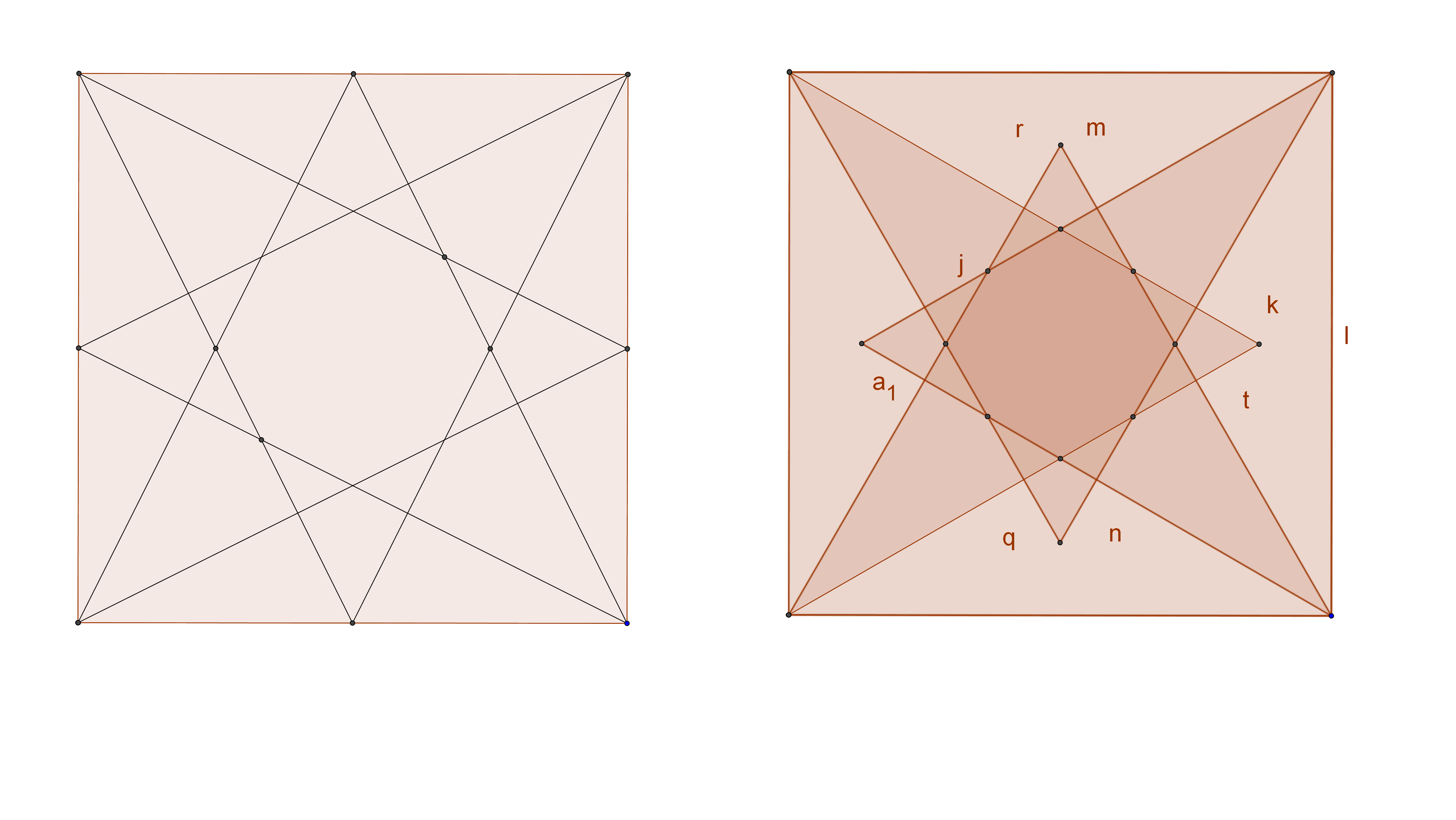
John's Original Inquiry Question
John’s Original Inquiry Question

I’m asking him, “What did you do? How did you get that?”  He says that he just started playing with the square and doing different things to it and ended up reflecting equilateral triangles into the square instead of connecting the vertices with the midpoints as in the original French Garden Problem.  Then he started seeing how much of the area this octagon was and it ended up that it was……you don’t think I’m going to tell you, do you?

Anyway, it just made my night, to see the difference in John when he came by and the by the time he left.  He was elated – like he had discovered the Pythagorean Theorem or something.  I just love this project and I would encourage anyone else to do the same thing.  Leave a comment if you end up doing it because I love to hear about any improvements I could make.
Blog challenge Day2: New Technology for Collaboration in PBL

For the past two years, I have been lucky enough (or unlucky if you are less inclined to use technology) to have classroom sets of iPads for my geometry classes and have been able to experiment pretty easily with some different ways of teaching – collecting homework electronically (that was a fail), using Geogebra and Notability to get some really nice diagrams (that was pretty great!) and working with Voicethread to have students collaborate at home during homework. I gave a CwiC session talk last year at the Anja S. Greer conference on my use of Voicethread as a means of collaboration in problem solving and it went over really well. Here’s an example of how students used it:

So since I felt like that was so helpful as a discussion forum in the evenings (and also allowed more time in class for discussion the next day), I wanted to find other apps that might be just as helpful.  One of the things kids didn’t like about Voicethread was that it forced asynchronicity – there was no way to talk to someone online.  In fact, what sometimes happened was that a student would post a question and no one would respond until maybe 11 pm, and then by that time they might’ve gone to bed or moved onto their French homework or something.  Bummer.

So now this year I’m going to try a new app called Talkboard.  This is a really cool app that allows a student to send an IM or email to another student (or more than one) and then have a conversation (with voice) while also seeing writing and drawing real-time.  These synchronous discussion are kept in “projects” that can be saved and even exported as a pdf (without sound sadly) but there can be a record of their ideas.  Students can come to class the next day with some work on the iPad that contains the ideas they had for the problem solving process.  You can keep adding pages to the project and you can also import pictures – like graphs and diagrams from geogebra or desmos.  So I’m pretty pumped to try this out.

If anyone has used this app and has some experience with it, I’d love to hear about it!  Thanks so much!  …and happy experimenting!

What does “making students metacognitive” mean? – answering “why should someone learn?” in Math

So I recently tweeted a nice article that I read that discussed “12 Questions to Help Students See Themselves as Thinkers” in the classroom (not specifically the math classroom


and appropriately, Anna Blinstein tweeted in response:


So I thought I needed to respond in a post that spoke to this question. First of all, I should state the caveat that even when I am in a more “standard” classroom (i.e. not a PBL classroom) – which happened to me last year – I try as much as possible to keep my pedagogy consistent with my values of PBL which include

1) valuing student voice
2) connecting the curriculum
3) dissolving the authoritative hierarchy of the classroom
4) creating ownership of the material for students

I find that helping students to be metacognitive helps with all of this. An important aside her is also Muller’s definition of 21st century learning* which is much more than that 20th century learning and education that often comes with direct instruction in the mathematics classroom (not always).I think it’s important to note that the more fluid concept of knowledge that is ubiquitous with technology today and is no longer static in textbooks or delivered by teachers.  Students can go find out how to do anything (procedurally) nowadays, but it is the understanding of it that is more important and the true mathematical learning and sense making.

Anyway, I think I would write way too much if I responded to every one of the questions, but how would I use these questions in my direct instruction class that I taught last year?  What I tried to do was introduce a topic with some problems (and then we would do some practice with problems from the textbook so I could keep up with where my colleague was in the material).  Well, this course was Algebra II, which often referred to prior knowledge that always reminded students of something they had studied before.  I let them use computers to look things up on the internet and use the technology at hand, GeoGebra, Graphing Calculators, each other to ask questions about the functions we were studying.  They could look up topics like domain, range, asymptotes (why would there be an asymptote on a rational function)…but then the bigger questions like “what am I curious about?” had more to do with how did those asymptotes occur, what made vertical vs. horizontal asymptotes and then I would have them do journal entries about them (see my blogposts on metacognitive journaling – journaling and resilience, using journal writing, page on metacognitive journaling).

The more “big picture” questions like “Why learn?” and “What does one *do* with knowledge?” I find easier to deal with because the students ask those.  I think that all teachers find their own ways to deal with them, but I enjoy doing is asking students about a tough question they are dealing with in their life – I use the example of whether or not I should continue working when I had my two kids.  Was keeping my job worth it financially over the cost of daycare? and of course I had to weight my emotional state when I wasn’t working – this is why I enjoy learning and what I do with my knowledge.  When kids see that there’s more to do with functions than just points on a grid, it becomes so much clearer for them – but you know that!

What I really like about Dr. Muller’s list is that he lays out some nice deliberate ways in which we as math teachers can get students to think more clearly and reflectively about mathematics as a purposeful process as opposed to a just procedures that they can learn by just watching a Kahn Academy video.


*”Learning – here defined as the overall effect of incrementally acquiring, synthesizing, and applying information – changes beliefs. Awareness leads to thoughts, thoughts lead to emotions, and emotions lead to behavior. Learning, therefore, results in both personal and social change through self-knowledge and healthy interdependence.” Muller http://tutoringtoexcellence.blogspot.com/2014/08/helping-students-see-themselves-as.html

Why I disagree with Mr. Kahn

I have to say that I am not usually a controversial blogger – I’ll just put that out there right away.  However, I am so frustrated with the conversations, blog posts and articles that are zipping around the blogosphere about online learning, MOOCs and Khan Academy that I have to say something about it as a teacher, teacher educator and responsible learner, myself, about education theory.  I have taught online classes, taken online classes, used open source materials for my classes and definitely promote the idea of equal “world-class education for anyone, anywhere.”  However, I have yet to see how that quality education occurs online and especially the way that it is promoted in Salman Khan’s book, The One World Schoolhouse: Education Reimagined.

Now let’s just put something else out there right away – it might be that I am frustrated by the fact that he has no background experience in education (which he admits – “I had no teacher training”) and I am offended that he is speaking out of turn speaking as if he does.  For example, he says “There’s an old saying that ‘life is school.’”  Hmmm, I wonder who said that? And I’m not sure that’s really the right saying.  Or it could be that he is attacking the very discipline that I am working so hard to change – mathematics.  I totally agree that there is a lot that is wrong with the way mathematics is taught in the U.S.  But NOT going all “rogue” and working against the people who have already done some research on the subject and know a little about which they talk, might be a good place to start.  There are many things that Mr. Kahn discusses in his book that he seems to purport as novel ideas like Mastery Learning, Flipping the Classroom, etc. that are not his ideas.  So let’s pretend that the fact that he wrote a book of concepts that seem to be a compilation of educational reform ideas that have been around for a while is not what really annoys me.

What really gets my goat, if I seem to have his idea right, is that he is advocating for “a free world-class education, for anyone anywhere” but I’m not really seeing how this is going to happen.  He advocates for the use of the Khan Academy for mastery learning in the classroom (in a school system) where the students watch the videos and then come to class and do “projects” with each other in the “one room schoolhouse.”  I actually agree that this is a wonderful learning scenario that promotes creativity, independence in learning and individualized lessons for students of all ability levels.  Besides the huge government and system-wide testing restrictions that are currently in place and teachers’ current use of assessment, it would be very difficult (but not impossible) to change this system.  Kahn very naively writes a 5-page chapter on Tests and Testing, which again is nothing new, on the evils of standardized testing and why they don’t really tell you anything about students’ knowledge.  His “one room schoolhouse” is an idealistic utopia of learning for someone who has never been in the classroom and dealt with classroom management, assessment, review or planning of these open-ended projects.  I do believe that a great deal of teacher training would need to be reformed and reviewed in order for something like this to happen and before any school thinks of moving to a model like this they should think wisely about the ways in which teachers are ready to handle the change of the classroom culture and how they are ready to deal with it.  Students will still have questions about the material and will all be at different places in the content and the projects, which will probably demand more planning from the teachers (which again, is not a reason not to flip the classroom, but a necessity of which to be aware). I found what he put forth as the ideal classroom short-sighted and with many limitations.

Secondly, what about the “anyone, anywhere” Idea? Even if children in third-world countries have access to internet-ready computer to watch these videos, where are the teachers and schools to have them do the “world-class” learning with these group projects?  Where is their utopian learning environment?  I am confused about how watching videos online is giving them a “world-class” education (although I could see how it was free if Mr. Gates donated a bunch of computers and Internet access, etc.).  Mr. Kahn also realized that “teaching is a …skill – in fact, an art that is creative, intuitive, and highly personal…[which] had the very real potential to empower someone I cared about.”  Yes, Mr. Kahn, that’s what teaching is all about.  Teaching is about, as you said, “genuinely [sharing  your] thinking and express[ing] it in a conversational style, as if I was speaking to an equal who was fundamentally smart but just didn’t fully understand the material at hand.”  How is that supposed to happen for someone sitting alone watching a video?

In the NY Times article, The Trouble with Online Learning, Mark Edmunson wrote:

“Learning at its best is a collective enterprise, something we’ve known since Socrates. You can get knowledge from an Internet course if you’re highly motivated to learn. But in real courses the students and teachers come together and create an immediate and vital community of learning. A real course creates intellectual joy, at least in some. I don’t think an Internet course ever will. Internet learning promises to make intellectual life more sterile and abstract than it already is — and also, for teachers and for students alike, far more lonely.”

This is the heart of Relational Pedagogy, that the interhuman connection between people is what constructs knowledge and the trust, authority, and value of perspective that is shared and given to each other is just as important as the content that is exchanged – most especially in mathematics, it’s just taking us a lot longer to figure this out, Mr. Kahn.

The Role of Technology in Relational Pedagogy?

So I’ve been thinking a lot lately about technology and learning.  There’s so much in the news about MOOCs, using iPads, schools using technology, etc.  I am even part of a pilot program at my school right now where all of my students have iPads in my honors geometry class and we are trying to communicate at night using Voicethread and the iPads.  My hope was that having a way to share ideas during the evening would lessen the stress of homework problems that students are asked to grapple with in the PBL curriculum would give them more opportunities to throw out problem-solving ideas with each other before class starts so that we would spend less time in class debating different methods of solving the problem (although that’s what I love about class, right?).

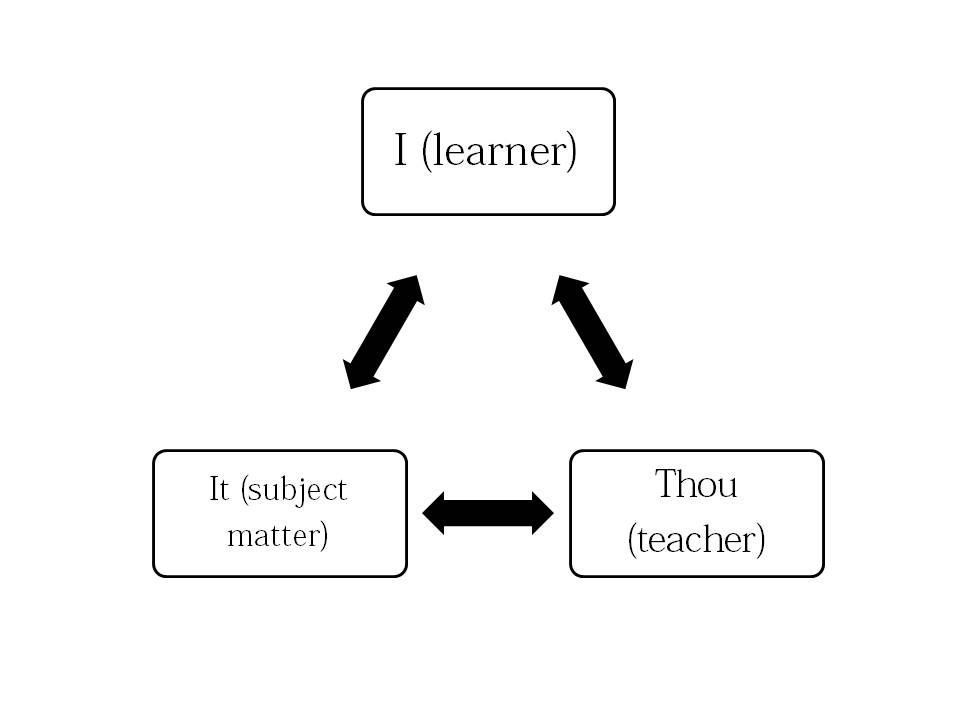
But I’m asked as a teacher to find ways to integrate technology into my classroom – but to what end?  I want to find ways to use technology to solve problems, to explore ideas and to help improve students’ understanding of the mathematics.  Not necessarily help them communicate with each other, which is what I’m finding most of the apps out there are for right now – which I am open to – but they are removing a huge part of the learning triangle.  In fact, David Hawkins (1974) wrote about the I-thou-it reciprocal relationships in learning that simply must exist between the learner, the teacher and the subject matter.  He said that if one of the relationships is hindered or dysfunctional in some way, that learning is not optimal.

Hawkins (1974)

So if I interrupt that relational triangle between the students’ communication with the material (and with each other) and with me, using technology instead of discussion and the connection with all three, my fear is that learning is not optimal.  Perhaps the technology could enhance it, but for now I see that it is not truly happening.  My guess is that it has to take time for the students maybe to want for that to happen.

I also just read an article on Edutopia by a guy named Matt Levinson that was entitled “Where MOOCs Miss the Mark: The Student-Teacher Relationship” where it was stated that a lack of mentorship, close guidance or meaningful relationship between teachers and students is what is really lacking in these online courses. Even students who use Khan Academy lectures for “learning” sometimes comment that even though they don’t like sitting and listening to lectures in math class, they would “much [prefer] listening to her math teacher explain the same concepts because she likes this teacher and feels comfortable asking questions and going for extra help outside of class.”

Carol Rodgers (one of my most favorite people on earth) writes about teacher presence and the importance of it in the classroom.  I believe in mathematics class and especially the problem-based mathematics class it is truly essential because in order for students to take a risk with a method, they need to feel supported and safe in order to be open to new ideas and to discuss them with others.  With the open presence of a teacher and mentor, students are not “receiving knowledge” but creating it with others – creating it within those relationships that Hawkins was talking about – maybe with technology or without it.  But  for someone who just spent two years writing about the importance of relational pedagogy in PBL, I find it extremely difficult to assume that without those relationship the same exceptional amount of learning would go on.