Handouts – Front and Center

I always try to make it easy for people to find both my slides and handouts when I give a talk – so Here’s my powerpoint presentation from my talk entitled, “Change the Classroom, Not the Students: Creating Equity with PBL”  which I’m giving today at the NCTM Annual Conference in New Orleans – great to be here.  I also have 2 handouts which include my framework for a relational PBL class and the results of my qualitative dissertation – I’d love to hear any comments and questions and start a discussion with PBL teachers. (I do not include the videos I used in this public version of the powerpoint, sorry)


Schettino Framework Handout

Schettino Sample Problems Handout NCTM2014

There are actually a few talks here today that I would highly recommend and seem to be related to this topic of creating a classroom that allows for discussion and interaction at the level of creating equity.  One of them is on Friday, and is entitled “The Hidden Message: Micromessaging and Mathematics” and it seems to be about managing the way we talk to each other in the classroom and making sure all voices are heard.  I’m definitely going to that one!  Unfortunately, Jo Boaler is presenting at the exact same time as me!  I don’t know if I should take that as a compliment that I was put as the same time or not 🙁

Well, hope everyone has a great time!  Enjoy the conference!

Having Students Be More Aware of their Contributions in PBL

One of the things I do at the middle of the term to have students reflect on the way that they talk about mathematics in class, is have them evaluate their work with my Student Self-Report on Class Contribution and I give them detailed feedback on their rankings of each type of question and what I think about their work so far.  But what I’ve found in the past is that it’s hard for them to remember specific examples of when they “helped to support the point by contributing evidence” or “raised a problem in another person’s solution” weeks or days after the fact.  Students have so much to think about during a class period that it really needs to be “in the moment” for them to be deliberately thinking about what they are doing and saying to each other.

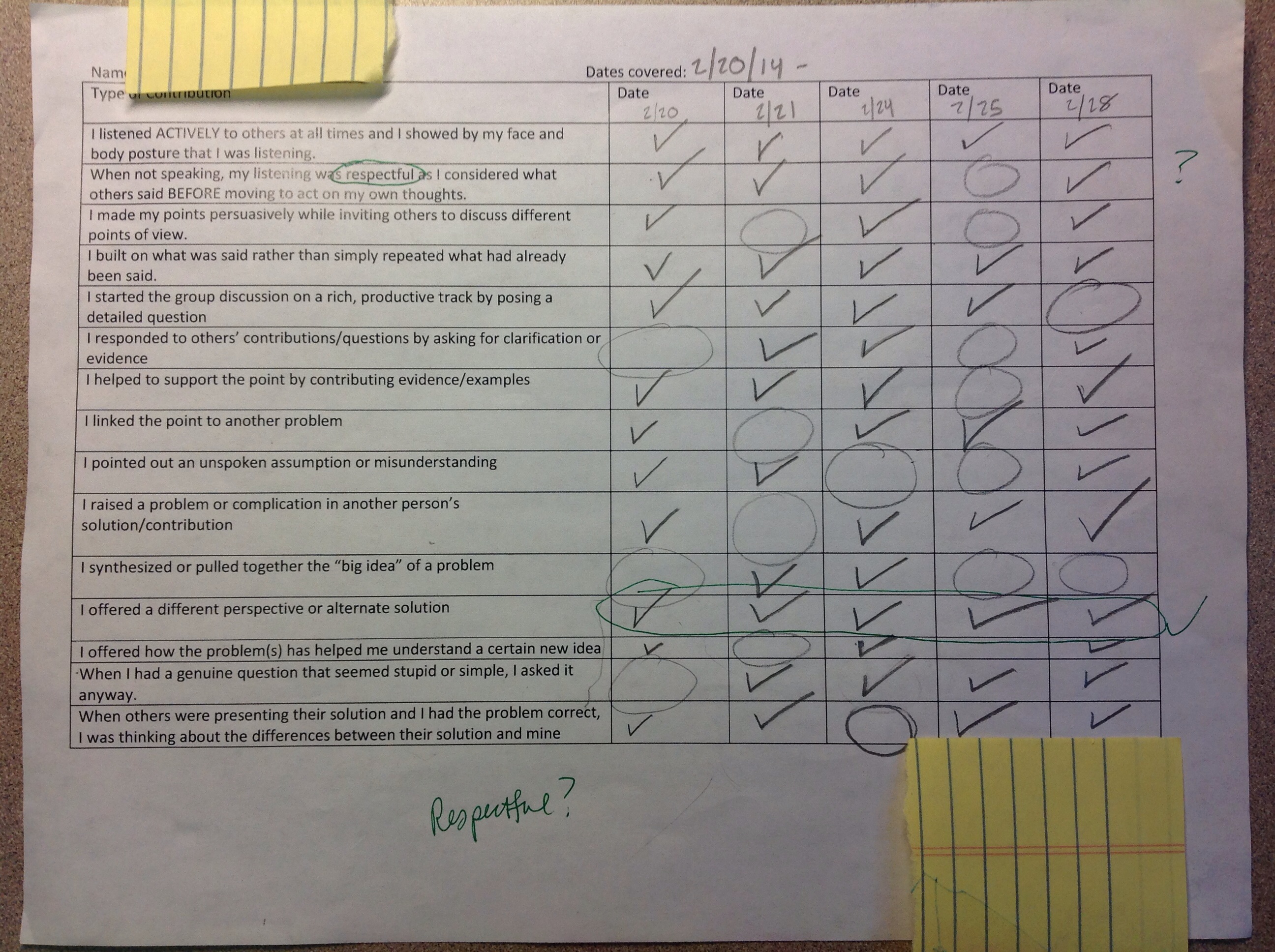
So I had this idea that I would actually have them keep track of the types of questions and comments they made to each other over a five day period at the end of the term and then hand it in to me.  This way they would check off each category of question or comment at the moment when they did it.  So I made copies of this table of Student Analysis of Contribution and had them keep it on their desks while we were discussing topics or problems in class.  They had to have something to write with while they were talking and taking notes too.

Initially the students were very concerned about how they were going to tell the difference between each of the types of contributions.  But little by little, it became easier.  These categories were not arbitrary, they happened all the time, they just hadn’t really thought about it before.   For example, when a student presented a problem but had made an error and didn’t know it, another student usually “raised a complication in another person’s soltuion” or “pointed out an unspoken assumption or misunderstanding.”  These are important contributions that they were making every day about mathematics and are important critical thinking skills they didn’t even realize they were developing.  I just wanted to help them be more specific about realizing it.

The first day we did this I heard some students say something like, “Ooh, I just…(brief pause while looking at the table)… ‘started the group discussion on a rich, productive track by posing a detailed question.” with pride and excitement (and maybe a little sarcasm).  But after three days of doing it, and students seeing that they had places that they could check off, one student actually said, “I think that this table makes our conversations more interesting.”

Here are some samples of student feedback:

Quiet student who needs to work on all types of comments and questions

This first respondent is a student is very quiet, and she knows it.  She rarely speaks in class, but is actively listening.  I’ve spoken to her about why she does not ask questions or share her ideas in class and she says that she is afraid of being wrong in front of everyone.  My hope all year has been that seeing everyone else be wrong regularly would eventually show her how acceptable it was in class.  It was clear that using this table showed her that there are many different ways to contribute to class discussion.  When she presented her problems in class (which she will do when asked) she is very capable and knows that she is contributing evidence or examples, but she rarely questions others’ work.  I do remember the time when she “built on” what was said by asking a question about someone else’s solution.  She also sometimes asks for clarification of her own understanding, but I know that she’s capable of more.  I struggle with how to encourage her to get more out of class discussion, but at least now she knows how important a role she can play.

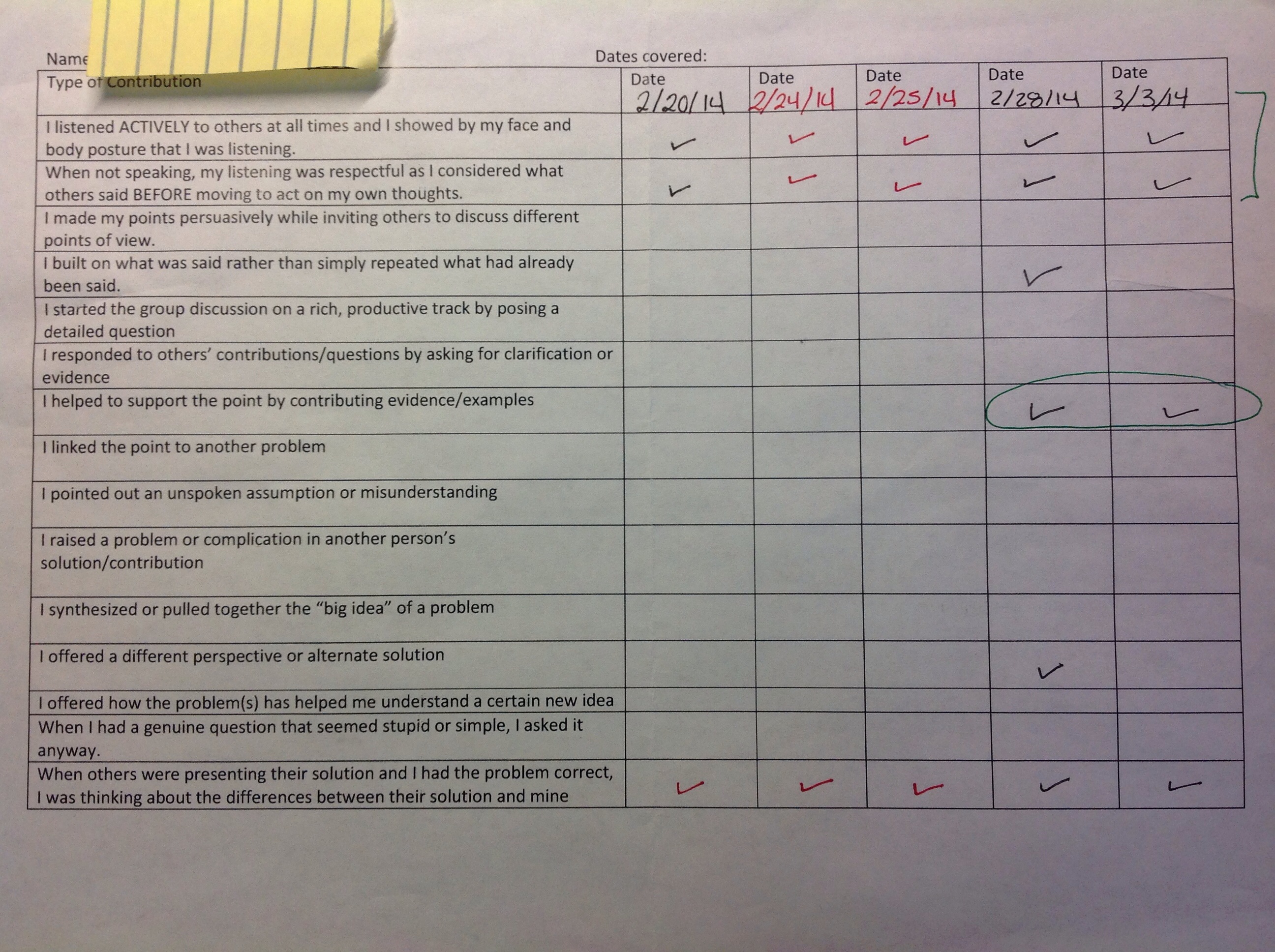
Outgoing student who lacks interaction from other kids

This is a really interesting student who is quite inquisitive and very comfortable with sharing his ideas.  When he has a question or comment, it’s very easy to get him to go to the board and naturally start writing another idea or possible solution method.  However, I noticed was missing in his table were checks in the two rows that had to do with “inviting others” into his thought process and also making comments on others’ solutions and ideas.  It made me wonder how much time in class he spends listening to other students talking or if he is just listening to his own ideas in his own mind.  I am working on trying to get him to collaborate more – with his creative mind it would behoove him to start interacting more with others.

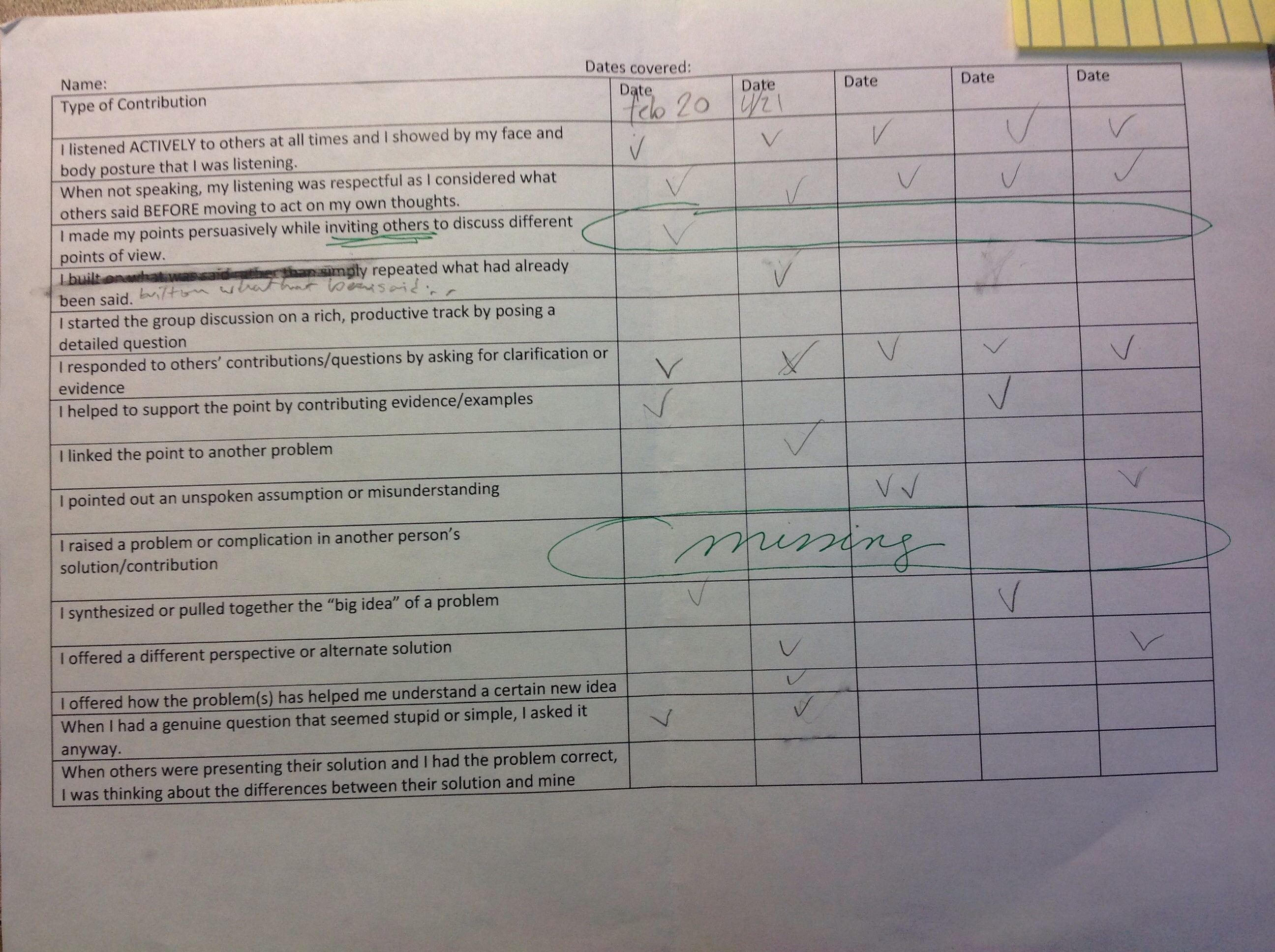
Outgoing student who is unaware of his effect on others

This table belongs to a student who really has overestimated his contributions to class.  He definitely spends a lot of time talking (and hence I spend a lot of time managing his unrelated talking unfortunately) and thinks that talking – any kind of talking – is useful and contributing to class discussion.  One of the things I have talked to him about is the idea of active listening and how important not speaking can be.  He has not yet caught onto the idea of being respectful while listening, and still is considering his next talking move while others are trying to make their points.  It will be a difficult discussion, but a necessary one for this young man to grow in important ways.  At least I now have this chart to refer to when I have that discussion.

So was this exercise everything I had hoped?  Not really – but it definitely had some great highlights.  Class discussion was very exciting and interesting while students were aware and deliberate knowing the different types of ways in which they could contribute.  Knowing that they had to hand this table in to me in 5 days was putting the onus on them to show that they had or had not fulfilled what I had observed of them in class.  I do believe they learned a lot about what they were capable of.  I do believe I would do it again.

Does PBL teach Resilience?

I just read a great blogpost by a business writer, Gwen Moran, entitled, “SIx Habits of Resilient People.” When I think of people that I admire in my life for their resilience there was usually some circumstance in their life that led them to learn the quality of resilience because they had to. Even the examples that the author uses in this blogpost – being diagnosed with breast cancer, almost being murdered by a mugger, the inability to find a job – these tragedies that people have had to deal with can be turned into positive experiences by seeing them as ways in which we can learn and grow and find strength within ourselves.

But wouldn’t it be great if it didn’t take a negative experience like that to teach us how to be resilient? What if the small things that we did every day slowly taught us resilience instead of one huge experience that we had no choice but to face? Having to deal with small, undesirable circumstances on a daily basis, with the help and support of a caring learning community would be much more preferable, in my opinion, than surviving a mugging. (Not that one is more valuable than the other). But I just wonder – and I’m truly ruminating here, I have no idea – if it is possible to simulate the same type of learning experience on a slower, deeper scale by asking students to learn in a way that they might not like, that might make them uncomfortable, that asks more of them, on a regular basis.

I think you know what I’m getting at. Does PBL actually teach resilience (while also teaching so much more)? In my experience teaching with PBL the feedback I’ve received from students has been overwhelmingly positive in the end. But initially the comments are like this:

“This is so much harder.”
“Why don’t you just tell us what we need to know.”
“I need more practice of the same problems.”
“This type of learning just doesn’t work for me.”

Having students face learning in an uncomfortable atmosphere and face what is hard and unknown is difficult. Thinking for themselves and working together to find answers to problems that they pose as well as their peers pose is very different and unfamiliar. But does it teach the habits that Gwen Moran claim create resilient people? Let’s see. She claims that resilient people….

1.Build relationships – I think I can speak to this one with some expertise and say that at least if the PBL classroom is run with a relational pedagogy then it is very true that PBL teaches to build relationship. My dissertation research concluded nothing less. In discussing and sharing your ideas, it is almost impossible not to – you need relational trust and authority in order to share your knowledge with your classmates and teacher and this will only grow the more the system works for each student.

2. Reframe past hurts. – If we assume that real-life “hurts” are analogous to classroom mistakes, then I would say most definitely. PBL teaches you to reframe your mistakes. PBL is a constant cycle of attempting a problem->observing the flaw in your solution ->trying something else and starting all over again. This process of “reframing” the original method is the means by which students learn the the PBL classroom.

3. Accept failure – This may be the #1 thing that PBL teaches. I am constantly telling my students about how great it is to be wrong and make mistakes. You cannot have success without failing in this class. In fact, it is an essential part of learning. However, students in the US have been conditioned not to fail, so that reconditioning takes a very long time and is a difficult process.

4. Have multiple identities – In a traditional classroom, certain students fulfill  certain roles – there’s the class clown, the teacher’s pet, the “Hermione Grainger” who is constantly answering the teacher’s questions, etc. But what I’ve found happens in the PBL classroom is that even the student who finds him/herself always answering questions, will also find him/herself learning something from the person s/he thought didn’t know anything the next day. Those roles get broken down because the authority that once belonged only to certain people in the room has been dissolved and the assumption is that all voices have authority. All ideas are heard and discussed. PBL definitely teaches a student to have multiple identities while also teaching them a lot about themselves, and possibly humility, if done right.

5. Practice forgiveness – This might take some reinterpreting in terms of learning, but I do believe there are lessons of forgiveness in the PBL classroom. Students who expect themselves to learn everything the first time and when they don’t, feel stupid, need to forgive themselves and realize that learning is an ongoing process. Learning takes time and maybe needs more than one experience with a topic to see what the deeper meanings and understandings really are. Since PBL is not just a repetitive, rote teaching method, students need to learn how to be patient and forgiving of their own weaknesses as a learner and take time to see themselves as big picture learners.

6. Have a sense of purpose – This habit is about “big picture” purpose and looking at a plan. From the research that I did, I also found that PBL brings together many topics in mathematics, allowing students to see the “big picture” connections between topics much better than traditional teaching does. The decompartmentalization that occurs (as opposed to compartmentalizing topics into chapters in a textbook) is confusing at first because they are not used to it, but eventually students see how topics thread together. Just the other day in my geometry class we were doing a problem where they were asking to find as many points as possible that were 3 units away from (5,4) on the coordinate plane. A student in the class asked, “is this how we are going to get into circles?” The whole class was like “Oh my gosh, it is, isn’t it?” Bam, sense of purpose.

All in all, I feel that PBL meets Moran’s criteria of “resilience characteristics” in ways in which it allows students to practice these habits on a regular basis.  So not only does PBL help students learn collaboration, communication and creativity, but perhaps they will see the benefits over time in learning how to move forward from a setback – just a little.
 

Minimizing Shame in the PBL Classroom…and maybe Daring Greatly?

I recently read a blogpost by one of my favorite authors, Brene Brown, of TED talk fame, and the author of a great book about vulnerability called Daring GreatlyIn her blogpost Brene wrote about some reactions to a comment she made on Oprah Winfrey’s Super Soul Sunday show where she talked about shame in schools about which she received a great deal of criticism in the blogosphere and on twitter.

I kept reading as I was shocked that anyone would be offended by anything that Brene Brown could say – especially teachers.  She has always been extremely inspiring and very supportive of teachers – as a teacher herself, her book, Daring Greatly, has a whole chapter on how schools can support a community to come together around vulnerability and become closer and foster creativity and innovation in this way.

However, she talks about the research that she has done about learning and teaching.  She says,

“As a researcher, I do believe that shame is present in every school and in every classroom. As long as people are hardwired for connection, the fear of disconnection (aka shame) will always be a reality. ..Based on my work, I do believe that shame is still one of the most popular classroom management tools.”

Think about it.  When you talk to adults about their memories of school, and specifically math classrooms, many people will tell stories of being embarrassed or humiliated about getting something wrong, about feeling less than adequate or unworthy of being in the class they were in.  Even if the teacher was not doing anything deliberate, if a student has the courage to answer a teacher initiated question and get it wrong, the response that is given can make or break their self-worth that day.

I’ve been giving this a lot of thought in the context of the PBL Classroom – How are we supposed to be teaching students how to take risks and not be afraid to be wrong and make mistakes in their learning if they have this fear of shame that is so deeply entrenched in our culture?  Especially in mathematics classrooms, how are we supposed to undo so many negative experiences that may have affected a student’s ability to allow themselves to be vulnerable and learn in this way?

PBL relies on the fact that a student is willing and able to make connections and conjecture regularly – numerous times in a class and on their own during “homework” time.  Being wrong and uncertain is really the norm and not the anomaly in this classroom.  As October rolls around and I hear more from students (and parents) about the discomfort they are feeling, I really do understand how different this is for everyone.  However, I do think we need to rely on the fact that students can be resilient and strong when pushed to try new things and to learn in a way that is good for them.  It is just that resilience that will make them better leaders, learners and more creative in the work force later on in life.

In talking to some students recently, I asked them where they thought they would learn more, in a classroom where it was laid out for them what they had to do or where they had to make choices about methods and sometimes it would be unclear.  I could tell that one girl was really struggling with that question.  She knew that it would be easier in the other classroom, but also knew that she would learn more and wanted to stay where her learning would be more effective.

What can I do to help this process go more smoothly?  Make sure that they know that I am working hard NOT to use shame as a classroom management tool.  That I am sincerely interested in the mistakes that they are making and how it is helping their learning.  I want them to grow from their errors and misconceptions and find ways to use those to their advantage.  I want to add to their self-worth not only as a math student, but as a problem solver in every way.

As Brene Brown says:

“I don’t believe shame-free exists but I do believe shame-resilience exists and that there are teachers creating worthiness-validating, daring classrooms every single today.”

I can be truly aware of the language that I use and the questions that I ask in order to make sure that everyone’s voice is heard and that my students know that I want to hear their ideas.  It’s really the only way to get them to Dare Greatly!

PS – Check out the wonderful quote by Teddy Roosevelt that I use in my PBL classes about Daring Greatly that Brene Brown used for the title of her book.

Get Comfortable with Uncertainty: A Short Dialogue

And so it begins.   The students are flustered. The emails are coming at night.  The faces stare at me, scared to death.  Although I repeat numerous times, “You do not have to come to class with each problem done and correct” students are totally freaking out about the fact that they can’t “do their homework” or they can’t “get” a certain problem on the homework.  No matter how many times I attempt to send the message the first few weeks about how unnecessary it is to come to class with a problem complete or an answer to show, students feel the need.

Tomorrow I am writing on my large post-it notes in HUGE capital letters, “Get comfortable with uncertainty because it’s not going anywhere.”  Every year about this time, I give the speech about how my homework is extremely different from any homework they have probably encountered in math class.  These are not problems that you are supposed to read, recognize and repeat.  They are there to motivate your thinking, stimulate your brain and trigger prior knowledge.  In other words,  you need to be patient with yourself and truly create mathematics.

Today I met with a young woman who I thought was about to cry.  She came and said, “I can’t do this problem that was assigned for tomorrow.”  Here’s how the conversation went:

Me: Why don’t you read the problem for me?

Girl:  Find points on the line y=2 that are 13 units from the point (2,14)

Me:  Ok, so show me what you did. (she takes out her graph paper notebook and shows that she graphed the line y=2, plotted the point (2,14)).  Great, that’s a great diagram.

Girl:  But it didn’t make sense because in order for it to be 13 units away, it had to be like, diagonal.

Me: Huh, what would that look like?

Girl: (drawing on her diagram) There’d be like two of them here and here.

Me; yeah?

Girl: But it can’t be like that….

Me: yeah? Why not?

Girl: Um…cause it wouldn’t be a straight distance.  I think..

Me: Is it 13 units away from (2,14)?

Girl: yeah, I think so…

Me: Hmmm….how far is (2,14) from the line y=2?

Girl:  Oh that’s easier – it’s like 12. ..Oh My gosh..it’s like a hypotenuse….and the other side that I don’t know is like the a and the 12 is like the b.  I can just find it.  Oh my gosh that’s so easy.  And the other one is on the other side.    Why didn’t I see that?

Me:  Well, you did…actually….

Girl: well, after you asked me that question…

Me: yeah, but eventually you’ll learn how to ask yourself those questions.


And they do….it’s just the beginning of the year.  We have to give them time – time to look into their prior knowledge as a habit, time to surprise themselves, time to have those moments, time to enjoy the moment and revel in the joy and courage and disappointment.  It’s all a part of the breakthrough that is needed to realize that they are creative and mathematics needs them to be.  It’s amazing and it’s worth it.

The Downside of Naming “Feminine” Traits

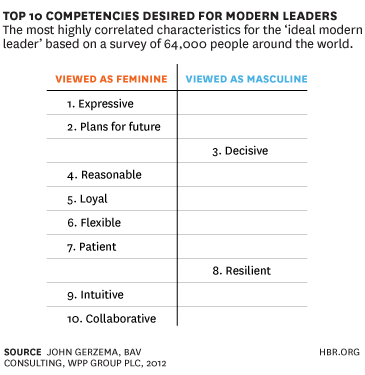
I recently read this article from the Harvard Business Review stating that “Feminine” Values Can Give Tomorrow’s Leaders an Edge.   A study was done asking 64,000 people from over 13 countries all over the world for the traits, skills and competencies that were perceived to be appreciated in leaders in the world of business and leadership.  The conclusions (from statistical modeling) that the analysts came to were that tomorrow’s leaders must overwhelmingly learn to have what our culture has defined to be “feminine” traits.  Here’s the list of the survey said were the top 10 desired traits for modern leaders:


I don’t disagree with these traits, honestly, and as a feminist it actually excites me that the values that I work to foster in the classroom are being valued in the boardroom and society in general (Dewey would be proud too).  However, something that is troubling me is the ever-popular dichotomy that is being set up here that seems to always be at the heart of many issues that rise in our society.  Something I wrote about in my dissertation and any time I talk about Relational Pedagogy is the idea of breaking down this concept of masculine vs. feminine thinking, not only in mathematics or education, but in human relations altogether.

I will be the first person to motivate and encourage young women in the STEM fields or take a young boy who likes cooking and say, “you, go guy” and hand him an apron – but that is about individualism and allowing young people to be who they want to be and feel empowered.  In my classroom, allowing students to see multiple perspectives and have their voice heard whether they are male or female is entirely my top priority because they are individuals and their relationship with mathematics is unique.  For a long time in math education, the ideas in this study were how young girls were viewed – researchers thought that if we just saw how girls were different from boys that we could see why they weren’t “doing as well” as boys.  However, we saw that they were doing just as well.

So my problem with this study is not the fact that women will be empowered to become leaders in business – no, that’s really exciting to me.  In fact, maybe some men will see the potential in women and decide to hire more women in the future and this will create more jobs for women and this will in turn, create a more equitable workplace and more favorable working conditions, which will then create more exciting options for business situations because of the fact that different perspectives are being looked at with such different views being taken in problem solving in business.  That is extremely exciting to me!

However, my problem with this study is this.  In order to make such radical changes in how people view gender differences in our society we really need to stop making such huge oppositional statements.  In support of this view, Mendick (2005) stated

By aligning separate-ness with masculinity and connected-ness with femininity, these approaches feed the oppositional binary patterning of our thinking and in the final analysis reiterate it (p 163).

If we just continue to point out how “unfeminine” men are because they are less expressive and how “unmasculine” women because they can be undecisive all we are doing is perpetuating the oppositions that separate us instead of our humanness that can bring us together as learners and our vulnerability that can help us problem solve with our strengths and weaknesses that will make us stronger if we work together.

There was an article published in 2010, about how if you put more women in a group of people the “collective intelligence” increases – the group works better together.  I’m sure there’s some tipping point though that if the group has all women there are diminishing returns for this measure.  There has to come a time when we value the relationships in our learning, our work and our classrooms and as teachers foster all of these traits to the best of our abilities.

So How Do We Shift Gears?

OK, OK, I get the idea – not everything on the Internet is true and, for sure, not everything on the Internet is meaningful or helpful.  Since April of this year I have started following a bunch of people on Twitter (before that I really didn’t even know what it was or care) and thought that there were so many people out there that I wanted to learn from.  I would read other people’s blogs and try my best to think about what I had to learn from others. Mind you, I know I am definitely not the god of teaching, that’s for sure, but many of the things that are written out there – should I guess – with the hope of being “inspirational” or meaningful to others, I find less than helpful.

One site that I have really enjoyed reading which often has some great links and blogposts is Mindshift.  But they just tweeted this blog entry that cited an article about creating a business that fosters creativity.  OK, I see the connection to education, but honestly, it is a very different machine.  Kids and adolescents have a very different mindset than adults who are out there making money.  Not to mention the consequences of risk-taking in the classroom vs. risk-taking in the office have the potential for being very different.  (Assessment for grades has a different meaning possibly for a 13-year-old mind than brainstorming on the job, vs. assessment for a salary raise, etc for an adult who we hope can handle the pressure a little more.)

Then the blogger writes two short paragraphs at the end about how schools are just “incurious and risk averse” places.  Basically stating that schools don’t ever allow students to practice risk-taking or mistake making at all:

“Too few schools are incubators of curious and creative learners given their cultures of standardization, fear, and tradition. No doubt, external pressures exist that drive that culture. But if there ever was a time to shift gears, this is it. “

No doubt…sadly, our blogger, Will Richardson doesn’t really give us any advice on what to do about it….except, to do something about it. (Admittedly, he may have written something someplace else that I missed.)  And I don’t want to single out Mr. Richardson – I find tweets and blogs like this all day long – “Exploration, inquiry & problem solving are powerful learning mechanisms…” or “asking good questions and promoting discourse is an integral part of teaching and learning”…. Hmmm, well let me think about ways in which we can talk to teachers  in terms of mistake making and risk-taking:

  • Blogpost on making mistakes and classroom activity tied to Kathryn Schultz’ TED talk On Being Wrong
  • Discussion about article “Wrong is not always bad” with teachers
  • Modeling risk-taking in Problem-Solving in my course at ASG conference in June
  • Discussion of Relational Pedagogy to foster Risk-taking
  • Using a PBL curriculum to foster mistake-making and communication

I found that many teachers that I work with and who contact me are entirely dedicated to changing the culture of the mathematics classroom in the U.S. and making it (as Mr. Richardson writes) an “incubator of curious and creative learners.”  We need to make changes to our curriculum, our classroom relationships, our classroom culture and the authoritarian hierarchy that traditionally is prevalent in our mathematics classroom.  Students need to be able to feel safe enough, from judgment, alienation and failure to make those mistakes while learning.  We, as teachers, need to begin the discussion with each other about how to move forward with these initiatives and make sure that student voice is heard in the mathematics classroom as they question each other and us, the teachers, with true questions – ones we may not be able to answer.  These are the important aspects of creating curious learners who make mistakes and learn from them.  But we, as the adults in the room have a responsibility to let them feel safe in doing that.

I think teachers are aware of the fact that it’s time to “shift gears” – to make the classroom more conducive to students working together and taking chances.  There are so many subtleties to making this shift, however.  Students who need to shift, parents who are not used to that, assessment changes to be made – the list goes on and on.  I am doing what I can to help people with this conversation.  The pedagogy of relation (I believe) is at the heart of all of this – keeping in mind that in order for people to be vulnerable and make mistakes, we need to consider the interhuman aspect of learning.  In a classroom where this connection has for too long been typically so acceptably removed, it will take a lot of work to make this big “gear shift” but I’m up to it – bring it on!

Affirming the “Un-fixing” of the roles in Mathematics

So after nine, long hard years, I am finally at a point where I am proud to say, “I’m finished!”  Woo-hoo and hurrah, tonight I will submit my dissertation electronically and you can call me Dr.  Reading over my work has been probably one of the most fulfilling acts of my professional life, as was defending my dissertation last week.  I can’t believe how fun it actually was – too true.  When you are passionate about a topic, it never gets old. Then, just today my advisor sends me an article that was published in the Harvard Education Letter titled, “Changing the Face of Math”which strangely sounds so much like what I’ve been working on for so long.  It talks about the current state of the way students create identities in mathematics in the U.S. and how this is detrimental to their beliefs about what they can do and be in the mathematics classroom and beyond.  Sadly, as high school teachers, half of our job is undoing the mathematical identity that the system has put in place all the years before they have come to us. In my dissertation, I wrote about not only this identity question but the difficulty in how American society has such a gendered, dichotomous view of mathematics that even those of us who attempt to move past the stereotypes because of our love of mathematics end up with difficult situations to work against.  For some, it is so difficult that we end up giving up and choosing the easier path – the girl who loves physics but choose biological engineering because she feels like she belongs there.  Or the young woman who goes to college to be a math major, but ends up in International communications because the classes were not taught in a way that worked for her learning style.  Or the weak female mathematics student who doesn’t even consider taking another math class in college because of the negative view of her abilities years ago. In this article they say,

“Math education experts say we’re in crisis and that traditional approaches of treating math like a cold-blooded subject amid the warm and engaging world of K–12 schooling are a big part of the problem. Narrow cultural beliefs about what math success looks like, who can be good at it, and what it’s used for are driving students to approach the subject with timidity—or not at all.”

Which was so affirming because it was the major educational research question that motivated my dissertation!  I love it.  Allowing all underrepresented students, not just girls to find ways to change the way they view themselves as math students by changing the way we teach mathematics would be revolutionary, and so many people are doing it.  I am proud to be a part of this movement to “unfix” the gendered, dominant, presumed ways of mathematics learning and open it up to more subjective, creative and collaborative thinking processes. It’s a great time to be a revolutionary!

Why I disagree with Mr. Kahn

I have to say that I am not usually a controversial blogger – I’ll just put that out there right away.  However, I am so frustrated with the conversations, blog posts and articles that are zipping around the blogosphere about online learning, MOOCs and Khan Academy that I have to say something about it as a teacher, teacher educator and responsible learner, myself, about education theory.  I have taught online classes, taken online classes, used open source materials for my classes and definitely promote the idea of equal “world-class education for anyone, anywhere.”  However, I have yet to see how that quality education occurs online and especially the way that it is promoted in Salman Khan’s book, The One World Schoolhouse: Education Reimagined.

Now let’s just put something else out there right away – it might be that I am frustrated by the fact that he has no background experience in education (which he admits – “I had no teacher training”) and I am offended that he is speaking out of turn speaking as if he does.  For example, he says “There’s an old saying that ‘life is school.’”  Hmmm, I wonder who said that? And I’m not sure that’s really the right saying.  Or it could be that he is attacking the very discipline that I am working so hard to change – mathematics.  I totally agree that there is a lot that is wrong with the way mathematics is taught in the U.S.  But NOT going all “rogue” and working against the people who have already done some research on the subject and know a little about which they talk, might be a good place to start.  There are many things that Mr. Kahn discusses in his book that he seems to purport as novel ideas like Mastery Learning, Flipping the Classroom, etc. that are not his ideas.  So let’s pretend that the fact that he wrote a book of concepts that seem to be a compilation of educational reform ideas that have been around for a while is not what really annoys me.

What really gets my goat, if I seem to have his idea right, is that he is advocating for “a free world-class education, for anyone anywhere” but I’m not really seeing how this is going to happen.  He advocates for the use of the Khan Academy for mastery learning in the classroom (in a school system) where the students watch the videos and then come to class and do “projects” with each other in the “one room schoolhouse.”  I actually agree that this is a wonderful learning scenario that promotes creativity, independence in learning and individualized lessons for students of all ability levels.  Besides the huge government and system-wide testing restrictions that are currently in place and teachers’ current use of assessment, it would be very difficult (but not impossible) to change this system.  Kahn very naively writes a 5-page chapter on Tests and Testing, which again is nothing new, on the evils of standardized testing and why they don’t really tell you anything about students’ knowledge.  His “one room schoolhouse” is an idealistic utopia of learning for someone who has never been in the classroom and dealt with classroom management, assessment, review or planning of these open-ended projects.  I do believe that a great deal of teacher training would need to be reformed and reviewed in order for something like this to happen and before any school thinks of moving to a model like this they should think wisely about the ways in which teachers are ready to handle the change of the classroom culture and how they are ready to deal with it.  Students will still have questions about the material and will all be at different places in the content and the projects, which will probably demand more planning from the teachers (which again, is not a reason not to flip the classroom, but a necessity of which to be aware). I found what he put forth as the ideal classroom short-sighted and with many limitations.

Secondly, what about the “anyone, anywhere” Idea? Even if children in third-world countries have access to internet-ready computer to watch these videos, where are the teachers and schools to have them do the “world-class” learning with these group projects?  Where is their utopian learning environment?  I am confused about how watching videos online is giving them a “world-class” education (although I could see how it was free if Mr. Gates donated a bunch of computers and Internet access, etc.).  Mr. Kahn also realized that “teaching is a …skill – in fact, an art that is creative, intuitive, and highly personal…[which] had the very real potential to empower someone I cared about.”  Yes, Mr. Kahn, that’s what teaching is all about.  Teaching is about, as you said, “genuinely [sharing  your] thinking and express[ing] it in a conversational style, as if I was speaking to an equal who was fundamentally smart but just didn’t fully understand the material at hand.”  How is that supposed to happen for someone sitting alone watching a video?

In the NY Times article, The Trouble with Online Learning, Mark Edmunson wrote:

“Learning at its best is a collective enterprise, something we’ve known since Socrates. You can get knowledge from an Internet course if you’re highly motivated to learn. But in real courses the students and teachers come together and create an immediate and vital community of learning. A real course creates intellectual joy, at least in some. I don’t think an Internet course ever will. Internet learning promises to make intellectual life more sterile and abstract than it already is — and also, for teachers and for students alike, far more lonely.”

This is the heart of Relational Pedagogy, that the interhuman connection between people is what constructs knowledge and the trust, authority, and value of perspective that is shared and given to each other is just as important as the content that is exchanged – most especially in mathematics, it’s just taking us a lot longer to figure this out, Mr. Kahn.