Doing What You Can

I just got back from a great visit to Toronto (which was also my first visit to that wonderful city.)  I spoke at a conference and also did some work at beautiful girls’ school there that was interested in PBL.  It was the first time where two of my research interests intersected (Gender and PBL) and it was fascinating for all that were involved – quite wonderful and so much fun.

Many teachers talked to me there (and it comes up everywhere I go) about the fact that they are the only teacher, or one of the few, at their school that is interested in  trying out this different method of teaching, but need to keep up with the syllabus that their colleagues are using in order for students to be prepared for the common exam either at the end of the term, the end of the semester or even on a monthly basis.

This can be problematic when there are school districts that dictate down to the homework assignment or classroom activity that you need to be doing on a daily basis.  The free that classroom practitioners need to make decisions about what is best for the learning of their students is quite important.  However, it is still possible to integrate problem solving or methods of PBL into your classroom when you can get.

I talk about the Continuum of PBL when I give workshops to let people know that you don’t have to dive in head first if you want to try your hand at classroom discourse a little at a time.  Learning to facilitate discussion as a long-time direct instruction teacher is actually quite difficult to allowing students to have more authority can be tricky.  Here is the visual aid that I use when I discuss it:
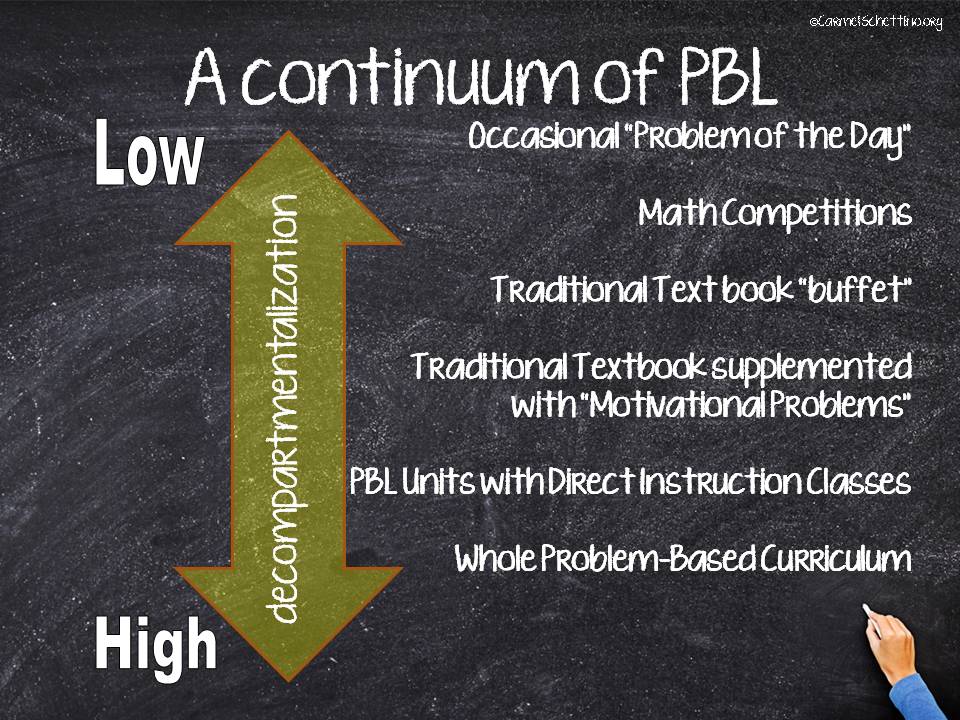
“A Continuum of PBL” cschettino 2013

The arrow tells you the level of decompartmentalization of topics – in other words how the topics are blended together or not.  In a traditional mathematics curriculum, a textbook artificially separates mathematics into what I like to think of a “compartments” that in a very linear order and most students learn to believe that mathematics must be taught in that order.  Yes, some operations and skills must come before others, but conceptually a great deal of mathematics can be learned or thought about in no particular order.  It is all extremely and equally fascinating.  In a whole problem-based curriculum such as what the faculty at Phillips Exeter Academy has written there are no chapters that mark the ending of the content and the beginning of another since there truly no time when that content is no longer applicable to the new material that is being learned (yes, of course that is true in a text book as well, but the chapter alone have come to imply that to students).

Decompartmentalization can come at different levels.  At the lowest level,many  teachers use “Problems of the Day” that challenge students at the beginning of class with logic puzzles, topics they are not seeing regularly or interesting tidbits like soduku or other fun activities to get students’ minds working.  These create discussion and allow them to see problem solving in action.  However, there is little connection to the mathematics that is being learned in the class proper.

I won’t discuss every type of PBL on the continuum or this will turn into one of my hour long talks, but I will say that if you are interested in attempting to keep up with your colleagues who are following a traditional syllabus but you might want to use less direct instruction I have a link to my “Motivational Problems” page in order for you to have them start the conversation based on their prior knowledge of material.  The problems are listed by topic and you can have them move forward in class by presenting problems and then have them practice with problems in the textbook.  Anyone who tries this – I’d love to hear from you!

This was how I first started at my last school and it worked well for me.  You can read my article from 2003 in the Mathematics Teacher to learn what it was like.  But it definitely moved me in the right direction.  Keep pushing on!

A New Year: Setting Up the Dialogue

As the new school year approaches, I’m re-editing, once again, my PBL text that has been a “work in progress” for about seven years now. Every year my colleagues and I at my old school would take the input from our department and the students in the course and improve upon the work. This is what the teachers at Phillips Exeter do every year to their original materials as well. I think the idea of the problem sets being organic and dynamic is really the only way to think about problem-based learning – to believe that you can learn as much from the students and how they view the problem as they can learn from the problems themselves. In fact, while cleaning out some old folders this summer I ran across this quote, which I believe, is from Freire:

“The problem-posing method does not dichotomize the activity of the teacher-student: she is not ‘cognitive’ at one point and ‘narrative’ at another. She is always ‘cognitive,’ whether preparing a project or engaging in dialogue with the students. He does not regard cognizable objects as his private property, but as the object of reflection by himself and the students. The students – no longer docile listeners – are now critical co-investigators in dialogue with the teacher. The teacher presents the material to the students for their consideration, and re-considers his earlier considerations as the students express their own. “

Pretty amazing the way he’s got it right there, I think. That once you put that problem out there, it is no longer yours, but everyone’s to work with and the students need to be part of the responsibility for the learning. It is presented to them “for their consideration” you must reconsider your earlier consideration once they express theirs. That’s the deal you make when you use PBL – that you will do those reconsiderations. It’s part of the pact.

However, the kids need to be part of the pact too. Wait, let me back up. So, I’m sitting at my computer typing and my son, who is going into ninth grade geometry this fall, asks me what I’m doing. I tell him and editing my geometry textbook for my class for the fall. He asks me if he’ll be using a book like that – that’s not a “normal” textbook. I tell him, I don’t think so – I think his school uses a traditional geometry textbook that pretty much will give him direct instruction in the classroom much to my dismay. And he says to me with a sigh of relief, “Phew…well, that’s just fine with me.”

Of course, I’m thinking…whoa, hold the phone. Have I failed as a parent? Have I not instilled any intellectual curiosity in my son at all that he wouldn’t want to have some type of investigation going on in his mathematics classroom? I also had a very interesting experience starting at a new school this past year that traditionally had mathematics classrooms that were taught with direct instruction. It definitely took some time for students to get used to the idea of a teacher that did things a little differently. Student expectations for being “given” knowledge were extremely high and my expectations for them to construct knowledge were extremely high. It was an interesting situation.

Anderson (2005) found that many teachers who taught with PBL-type pedagogies found reluctance and resistance in students for lots of reasons. Even though they enjoyed the classroom more and even learned better in the long run, there a few downsides. Because of the habits of mind that students have formed in traditional classrooms they do not feel they are being “successful” unless the known authority figure (a.k.a. the teacher) is telling them they are right or wrong. The typical “received knower” that many students are in American classrooms today have “grown accustomed to learning in a classroom that required little from [them] in terms of engagement with mathematics” and they find it difficult for themselves to take responsibility and control for their learning in the way PBL asks them to. What can even happen sometimes is that these kids who are resistant can glom onto a student that seems to take on the attributes of the teacher or authority figure (in their perception) and a small group can become a microcosm of the traditional classroom if a teacher is not careful.

However, from working with teachers for many years and my own personal experience, students are actually very adaptable. Spending time in the classroom with this type of learning, students learn to adjust their own expectations and realize how much of a give and take there is – how much support to expect and learn that they are pleasantly surprised by what they can accomplish on their own.

I’d like to think that even my own son would be proud of himself if give the opportunity and I might give him some problems outside of class this year just to see what he does with them. However, it is just that pact that I was referring to before that the students have to buy into. If they don’t do their share and express their considerations on the problems, there is no dialogue to reflect on, there is no sharing that has gone on. And there enlies the rub – you are back to square one with direct instruction. So I’ve told myself that at the beginning of the year this year, I’m making that part perfectly clear that they have just as much say in the dialogue about what we’re learning and I hope they get the point – at least faster than they did last year!

What’s the “P” in PBL?

One of the issues I talk about a lot with people who are interested in Problem-Based Learning is the “continuum” of integration that I use to tell people how they can implement it in their classroom. How do you want to incorporate the teaching with problems in your classroom? Magdalene Lampert wrote a wonderful book called Teaching Problems and the Problems with Teaching in which she chronicled her journey of teaching a fifth grade classroom for a year with problems (it’s an awesome book, BTW). The way in which you use the problems, the pedagogy you use, and the classroom community you set (the lack of hierarchy, the authority you allow the kids to have, the safety of the risk-taking, etc.) is all hugely important parts of the PBL environment. I found another “continuum” created by someone name Peter Skillen and a colleague named Brenda Sherry. Mr. Skillen, a lifelong educator from Toronto, Canada, doesn’t claim to be an expert in PBL, but has extensive experience in the world of education and has great ideas. Check out his blog if you have time.

He created a wonderful Continua to Consider for Effective PBL which I believe is definitely worth sharing. Although his “P” in PBL is Project, I believe his Continua (since there is more than one scale) is just as applicable to Problem-Based Learning. It reminds me a great deal of what I use in terms of implementation. He also has stated that anyone who would like to add categories should feel free, and I might actually work with that. His categories to consider are

Trust
Questioning
Collaboration
Content
Knowledge
Purpose

These are amazing to start off with and I would probably add a few more to those including authority (although, I think this is what he’s getting at with trust and locus of control) and perhaps also change the “collaboration” one a bit. It is pretty tricky – this idea of interdependent, independent or dependent learning – dependent on what? The teacher, other students, a textbook? Very complex ideas at stake here. Different types of PBL are being considered and in different frameworks. But what he and his colleague have put together is amazing start to an important discussion.

In fact, it’s really important to decide what you mean my “PBL” is? Even on the public shared website for the American Education Research Association Special Interest Group for PBL there is a “Statement on Nomenclature” about what PBL might be interpreted as meaning. There is an acceptance that there is more than one, and in fact many, meanings for the acronym “PBL” and what one person thinks it is may not be the same as another. I am very open to the understanding that when some contacts me about their own school’s interest in using PBL, I have many questions for them before we start talking about implementation.

Not to belabor the great article by David Jonassen that was published in the Interdiscipliary Journal of Problem-Based Learning, (see my other blogpost Worked Examples in PBL) but I really like the distinction he makes between Project-Based and Problem-Based Learning. What it comes down to for him really is the authenticity of the problem. It’s not really about how many, what kind, or how big the problems are that you have the students do. What it is about how did you plan (or not plan) the problems. He is calling it the difference between “emergent authenticity” and “preauthentication.” (definitions by Jonassen (2011). Supporting Problem Solving in PBL. Interdisciplinary Journal of Problem Based Learning 5 (2)).

Emergent Authenticity is when “problems occur during practice within a disciplinary field by engaging in activities germane to the field.” In other words, this is more like when you pose a problem to the students that is something that a mathematician might encounter in real life and an answer is truly unknown (like in real life!!) and they are engaging in that activity of not really knowing that answer and grappling with finding the tools and resources that they need to move forward to find a solution. That is when the authenticity of the problem (or project) is actually emerging as authentic.

Preauthentication is “analyzing activity systems and attempting to simulate an authentic problem in a learning environment.” In high school mathematics classes, this when the teacher knows they want their students to learn something specific from engaging in a specific type of problem or series of problems (mostly like what I do in my curriculum, honestly) and they “set up” a problem-solving situation, but make the kids think that it’s novel. The learning experience has already been analyzed by the teacher and the teacher is giving the students the authority to do the problem at their own pace and draw conclusions, struggle on their own. However, there is some control because it is really only a “simulation” and the teacher actually has more information that can be helpful in terms of learning outcomes, etc. The authenticity has already been “preauthenticated” so that it simulates the experiences of a mathematician as much as possible, but still has the learning outcomes, goals or desired content objectives that might need to be fulfilled.

Which is better? I don’t believe there is a “better”. I believe there is what works for your school, pedagogical beliefs, student audience, teaching style, etc. All of these wonderful categories are what must be considered when you and your department start on the journey towards incorporating PBL into your curriculum. There are many great choices to be made, but it is a long journey and cooperation with lots of reflection are definitely needed. So much to consider.


To Kahn or not to Kahn in PBL

Recently there have been some discussions going around the Internet concerning Kahn Academy and other Internet-based “teaching tools” and their applicability or acceptability in terms of pedagogically sound classroom use. You can check out Dan Meyer’s blog or tweets about the MTT2k project, which I find pretty amusing actually, or Kate Nowak’s blog entry where she stated “Enduring learning requires productive struggle and time to noodle out unfamiliar problems, posed by a teacher who knows what you’re ready for, and can provide expert scaffolding. Lecture-only instruction focused on mastering procedures is an impoverished substitute for doing mathematics, and it doesn’t matter if that lecture is in person or in a video.” To that, I, of course, say, “here, here.” I spent some time going over the Kahn Academy website this past spring when my son was having some trouble studying for his science final exam and he was looking for some review materials and I actually thought it was something of a helpful resource for him. However, I’m not quite sure that it would’ve been a helpful way for him to have learned about genetics the first time around.

On the website, Kahn Academy has a great mission of having open-source curriculum for everyone, everywhere, which I am wholeheartedly in favor of. I believe that education needs to be the great equalizer and one of the best ways to do that is to actually allow everyone equal access to the same quality of education. However, they also seem to take pride in the fact that there are now “5th graders relentlessly tackling college-level math to earn Khan Academy badges” perhaps at the detriment of their understanding or even at the skills that they should be learning at their grade level (and I am definitely not against kids exploring interesting advanced topics or even discussing non-Euclidean geometry before they get to college, for example). So it’s important for there to be balance, as I always say, between content and process.

So overall, I would say, I have no problem with Kahn Academy’s (or any online institution of learning’s) pronouncements that they are helping to “spread the wealth” of education, but I do wonder about the quality of the instruction. They have some very, very smart people working there with very good goals about making education accessible, with which I totally agree and for that I commend them. However, there are lots of theories of education – both online and face-to-face that need to be considered in order to claim that any actual learning (whatever definition of that you are also claiming) is actually happening.

Before educators who are within F2F classrooms move to using online tools to “flip” classrooms in order to substitute for other methods of instruction and claim to be using Project-based or Problem-Based Learning, I encourage everyone to really explore the pedagogical methods of that online tool. Is it congruent to what you would do in the classroom? Does it actually help facilitate the type of learning you would want your students to experience? Does it ask the questions or help with the explorations that you would want them to grapple with themselves? Do they get to the confident explanation and security in the knowledge that they would in a discussion? If not, look for something else. Or even better, ask the questions or pose the problems yourself or get the students to ask each other.

Parent resistance to PBL

I have been having a fabulous week here at the Phillips Exeter Academy Math, Science and Technology conference in New Hampshire. I have two sections of my course running on “Moving Forward with Problem-Based Learning” and it really seems like there’s a huge increase in the interest in the Exeter Teaching Materials here this year. Many teachers are finding ways to talk about the curriculum and pedagogy and learn as much as they can while they are here. I am impressed with the depth of the questions and the way people are sharing ideas and experiences.

In my course, some of the participants were sharing stories about how students and parents were resistant initially and continually to the idea of having PBL in their classrooms, specifically with the Exeter materials. I asked the class, “Why do you think parents are so emotionally invested in the way their children learn math?” For a few minutes many of them looked at me and really thought about it. It does seem that parents care deeply about their kids’ education or they wouldn’t even be saying something to the teacher or administrator. Or maybe it’s that they care about the grade – getting into college is a huge process this days, so every little thing helps and they may see this as an obstacle instead of something positive. Others even replied that the parents are frustrated that the learning isn’t clear and they don’t really understand what’s going on in the classroom.

I believe that is one of the closest reasons. It seems to me that parents want their children to learn the way that they learned in school. It is how they remember their experience and how they feel comfortable. It is safe – if they do poorly, they know why (or at least can claim they now why), if they do well, they can be proud and know why they did well. However, in this type of pedagogy, it is clear that parents do not have any frame of reference for how they can assess their child’s work.

I believe the basis of this is the fact that the traditional mathematics classroom in the U.S. is based on a very disconnected learning system. Students are in the classroom in order to listen to the teacher and make sure they understand. Any responsibility for the learning of their classmates is nonexistent and definitely not assumed. Any questions that the student asks when raising her hand is to clarify her own understanding generally. You are necessarily isolated from the rest of the class and by sitting passively and being a receiving learner, there is no mutual relationship with the teacher. In a PBL classroom, the whole way of learning is based on relationships – relationships between students, between the student and the material, the student and the teacher and the teacher and the material. If these relationships aren’t open and mutual, not much learning will occur. Responsibility for learning is everyone’s and the need for active engagement by all is paramount.

This type of classroom is so foreign to parents it scares them. The idea of placing so much of the success of learning on the relationships in the classroom is extremely foreign in a mathematics class. Are teachers capable of this? Are students able to make this switch? No wonder they are freaking out? Some students remember with fear the idea of speaking up in a mathematics class and being wrong and how embarrassed or humiliated it made them feel. One student that I interviewed relayed to me, in a sarcastic tone something like,”Sure we could ask questions, but they had to be her questions. The one she knew the answers to in order to move on, not the ones we really wanted to ask.” It is pretty clear that the culture clash of what society is afraid of and what must be done in mathematics classes needs to be addressed.

On Monday,Grant Wiggins spoke about what he thought needed to change in mathematics education in the U.S. He actually cited PBL as something that would push us in the right direction of having students practice and be more prepared to be better problem solvers in their life. Although I may not have agreed with all that Mr. Wiggins had to say that evening, I do believe that he was a great supporter of reform and the PBL curriculum that should prove to be one way that teachers can move students into being more empowered in their own learning in math.

I plan to spend the rest of the summer hopefully finishing up my dissertation and submitting in September. Any well wishes would be appreciated!

Worked examples in PBL?

Apologies for not writing in so long. Transitions can be hard and making my way through a new school, new place to live and way too many other changes in my life have caused me to put this blog lowest on the priority list. However, in preparing for my course at the PEA conference next week, I came across a wonderful article in the Interdisciplinary Journal for Problem-Based Learning by David Jonassen at the Univesity of Missouri. I have meant to write about this for quite a while because he write about “Supporting Problem Solving in PBL” and has created this great structure that describes the components and scaffolds for PBL environments. It kind of shows the different parts of a PBL environment and the cognitive ways in which students move through the environment focused on the problem, but how they navigate learning. One of the pieces that he talks about that was in this environment was “worked examples.” When I first read this, I was aghast and totally taken aback. How could this be? Why would someone propose that worked examples are part of PBL and isn’t this totally against everything that PBL stands for? I mean, why not just go back to direct instruction and have the teacher standing up at the board working examples for the whole class? OK, that’s a little extreme. I think I over-reacted and went to Jonassen’s part of the article where talks about this.

He states “The most common method for supporting schema construction is the worked example” which I believe is him stating that from a cognitive standpoint the “most common” way for a student to build a schema of seeing how to do something is for someone to show them how to do it. I do believe there is research that shows this. However, I do not believe that there is research that shows that this is the best way for the to construct a schema for understanding. In fact, Jonassen goes on to say that “worked examples should break down complex solutions into smaller meaningful solution elements, present multiple examples in multiple modalities for each kind of problem, emphasize the conceptual structure of the problem vary formats within problem types, and signal the deep structure of the problem…It is doubtful that worked examples are effectively applicable to very ill-structured problems. How can you model a solution that is unknown?” So if teachers did what he says here, they would work examples in many modalities – all representations so that the conceptual connections could be made and not just the procedural ones. Students would be able to see the bigger picture of mathematics more often because they would realize that in the real world they are not given problems that are repetitive and exactly like one that has already been worked out for them. They would be prepared for the fact that they could be given a problem that may have a solution that is unknown. We have a responsibility as teachers to prepare them for that possibility.

So I believe that what Jonassen is saying here is, don’t be afraid to, if necessary, stand up and work out a problem for a student if they are confused and ask you to show them something. That is part of your job to clarify a question or a process for them. However, it should not be part of the plan. Be open to different modalities of representing the work – not all students think the same and they need to see the differences in order to understand the full concept to big picture overall anyway. Limiting yourself to one way of working out an example is not helping them in anyway. So allowing yourself to be open to helping them “work it out” is really the best way to handle it for everyone.

Thanks for a great week!

Thanks to everyone who was in my PBL class this week. I had a wonderful time at the Anja S. Greer PEA Math Conference and met lots of wonderful people. For those of you in my week-long class, please feel free to fill out the course evaluation at:

Schettino Course Evaluation

So many teachers that I’ve met were extremely inspiring – As usual I learned so much from everyone about new ways to view technology, certain types of curriculum, ways to incorporate different topics in the classroom and even how to do a Rubik’s cube. I appreciate this converence so much and keep coming back every year. Thanks again to everyone. Special thank you goes out to Ron Lancaster for his special gift of the DVD movie version of The Housekeeper and the Professor which is a wonderful story of relationship through mathematics and creativity. I highly recommend it. Thanks so much Ron!

Many thanks

I have returned from my trip to Indianapolis and I would like to thank everyone that I met there for turning out to both of the presentations that I gave. The talk I gave on Saturday, which was with my colleague was more about our Problem-Based Learning curriculum at our school. The turn-out there was amazing and we were so impressed with the questions and comments from the group. Some of the feedback was great food for thought, especially some specific questions about our definition of PBL. It was also extremely useful to hear what teachers would feel are the challenges of implementing PBL in the classroom. I would direct some teachers to the blog of a teacher in Massachusetts named Mark Vasicek who has attempted to you PBL pretty consistently for a number of years West Side Geometry. It’s good reading.

I think that one of the reasons that so many people might be interested in even thinking about changing the way that they teach right not is because of recent work through the CCSS. There were so many opportunities at this conference to read about, talk about and learn about the details of the Common Core State Standards that I think by Saturday many people were almost tired of hearing about them. However, PBL definitely directly relates to at least a few of the CCSS standards of Mathematical Practice:

Making sense of problems and persevering in solving them.
Reasoning abstractly and quantitatively.
Constructing arguments and critiquing the reasoning of others.
Looking for and expressing the patterns used in reasoning.

We tried to give examples of how we see these standards coming to life as outcomes in student work on a regular basis in the PBL classroom. Having so many people come up to us afterwards for more information, or with interest in getting in touch was really exciting. Sunshine and I truly hope that you do. I really look forward to it.

Receiving Feedback

I received an email from a colleague a few weeks ago, that was amazingly touching. She had been meeting with an advisee and asked the thoughtful question, “Can you think of a course or a moment that changed your academic experience in a significant way.” One would think that most high school sophomores would either take that question lightly, or would at least need to pause and reflect on the depth of this question. My colleague said that her advisee responded without hesitation, “Geometry last year. I hated it at first because I couldn’t do what I had always done and do well. But by the beginning of the second semester, I had started to figure out what it was all about. And this year in my other classes, like English and history, I’m THINKING better, I’m analyzing differently because of that Geometry class.” This student seemed to be able to connect improvement in her critical thinking skills in other disciplines to the work she had done in her problem-based learning class. Did she have empirical evidence that this was the cause? Of course not, but something in her intuition and learning process was telling her that the struggle she had undergone to move through a course that challenged her in so many different ways, allowed her to grow intellectually like no other course had. For this student to even recognize this was very mature, and for her to attribute her success and skill in other courses to the learning that had occurred in this course was remarkable.

Throughout the year when teaching with PBL, I struggle with the comments I receive from students. I often wonder when they ask me to go up to the board and give more direct notes, “Why don’t I just go up and make them happy” instead of asking another scaffolding question? Why do I continue to push them out of their comfort zone and let them sit with the unknown for just that extra amount of time grappling with their peers, instead of relieving the tension and anxiety by giving them want they desire? And then a moment comes when they realize something on their own, and clarity, true understanding takes over. It is a moment of true joy on both our parts, because I know not only did they come to that understanding through their own agency and empowerment, but the way they came to it has allowed them to be the relievers of their own anxiety. They have transformed their vision of what is possible in coming to make meaning in mathematics. It is in that moment that we are together changing their understanding of what a mathematics classroom is, just a little more.

And then the next week, they are back to asking me for more direct instruction, while at the same time there is just a glimmer of increased curiosity and I know that by the end of the year, there will be a changed student sitting in front of me who may have a different belief system about learning mathematics.