Resources for talk NCTM Annual 2018 – Metacognitive Journaling

I hope there’s lots of interest in the lessons that I’ve learned from my years of having students journal. Here are some resources that you could use if you are interested in trying journals in your math classes.

Handout for NCTM Session Handout Schettino NCTM 2018

Blogposts about Journaling:

journals-paper-vs-digital-the-pros-and-cons/

what-i-get-out-of-student-writing/

revisiting-journals-getting-kids-to-look-back/

does-journaling-in-pbl-promote-resilience/

using-journal-writing-in-pbl/

Page: metacognitive-journaling/

Slides for Talk:


PBL: High Expectations or Learning to be Self-Directed?

One issue that seems to arise after teachers have been teaching with PBL for some time is the question of how students can remain active learners while listening, taking notes, comparing solutions, being engaged in discussion, etc.  All student-centered mathematics classrooms now have this issue don’t they?  Can a student learn well when they are being active in their learning? How do you allow them to both have agency by being part of the construction of knowledge but also have ownership by taking responsibility for the active part of learning.

Here’s a scenario: Grade 8 class has a student at the board presenting a method of factoring that is obviously confusing everyone – you know, they learned “the box method” somewhere else and are presenting it like it’s just a given that you are supposed to know this.  I’m observing this and I’m seeing at least 5-7 looks of confusion, maybe 1-2 students who are following the student and at least 3-4 who have checked out totally – maybe drawing a tree in their notebook.

How do you maximize this moment?  It is imperative that the teacher move in and ask questions that get at the student presenter’s understanding, especially if the other students are not asking questions.  There may be an air of “oh god, I’m supposed to understand what this kid is talking about” and others will not be asking good questions.

The teacher can ask questions like:

“OK, good work that you have a method that works for you.  Can you back up and explain how this method is showing what the factors of the quadratic are?”

“Let’s slow down a minute and see if there are any questions.”

“Why don’t you explain why you chose the number and variable you did for each box and what those boxes represent?”

“Can everyone else write down a question for …. and then we’ll share out.” (this can include making up a problem for those who do understand and seeing the presenter do another example)

These will bring the moment back to the group, wake them up to the fact that it’s OK to have questions and maybe an alternate method as well.  The kids who have checked out might feel validated in checking out.  But at the same time, checking out shouldn’t be an option. . How can we teach students to remain connected even when they really feel like all is lost?  In PBL, it is most important for student to have the tools in order to do this.

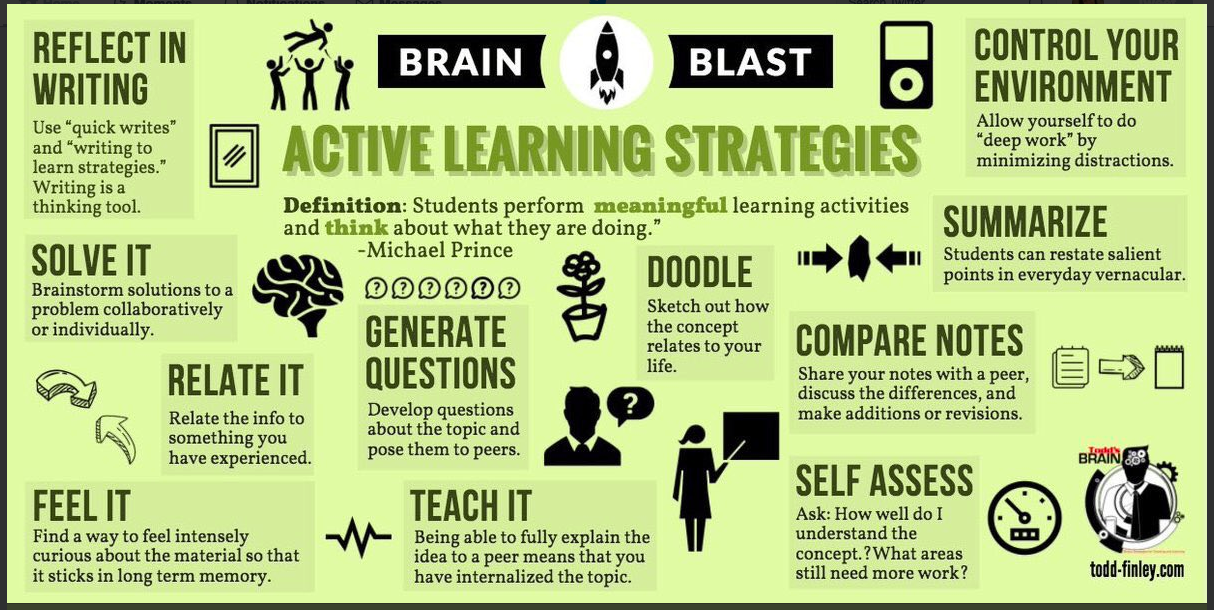
Today I saw this infographic tweeted by Brian Aspinall (@mraspinall) that does an excellent job of summing up ways to have students remain engaged when they want to check out.
Screen Shot 2018-02-23 at 2.59.57 PM

So many of these relate to the expectations for students in the PBL classroom.  Some of my favorites are

1. Reflect in writing – hugely important for the introverts in the PBL classroom and to share the floor and authority.

2. Relate it – not only to “something” you’ve experienced but another problem that you might have done that is connected to it!

3. Control your environment – How engaged you are is really your decision – How can students minimize their own distractions?  Of course day-to-day this will vary, and is developmentally different from grade 8-12 of course, but students, when aware of being distracted, can often find ways to get back into the work.

4. Self-Assess – this is one of my favorites – it keeps them engaged, makes them think critically and thinking ahead.

Allowing kids to know that doing all of these different behaviors in the math classroom is not only OK, but expected and encouraged, is part of teaching with PBL and encouraging the “active” in active learning.
Online Journal Course PreSale Going on Now

OK, so my online course for math teachers who are interested in learning about using meta cognitive journals is all ready to go. The official start day is next Friday Dec. 1, but if you register during this week prior, you get $50 off the full registration fee.

Click here for information on registering: Registration with Coupon

Here’s a description of the course if you are interested:
This course is an on-demand course geared towards middle and high school mathematics teachers who want to learn about journal writing in math classes. There are four main course lessons that range from the reasoning of using journals to how to assess them. Interaction can occur between participants in this course via the discussion forums with as much or as little time committment as participants desire.

Please share with anyone you might think is interested in learning about using journals in math class. Thanks so much!

How do you justify the time that PBL takes?

I just wanted to respond to a really great question that someone asked on Twitter the other day.

This is a common concern of teachers starting out with the idea of PBL. What does “Class Discussion” mean, first of all? I would agree that discussion does “eat up valuable” time in class on a daily basis, for sure. But what is actually happening in that discussion where something else would be normally happening in the math classroom? What does the discussion replace?

In my mind the discussion itself replaces the lecture, teachers ‘doing of problems” for the kids to then repeat, then kids often sitting on their own or in pairs doing problems that were just like the ones the teacher showed them how to do. The importance of the class discussion (which honestly is the main idea of PBL) is for students to share their ideas of prior knowledge, connections between problems, where they are confused and see where others were not confused and what prior knowledge and experience they brought to the problem.

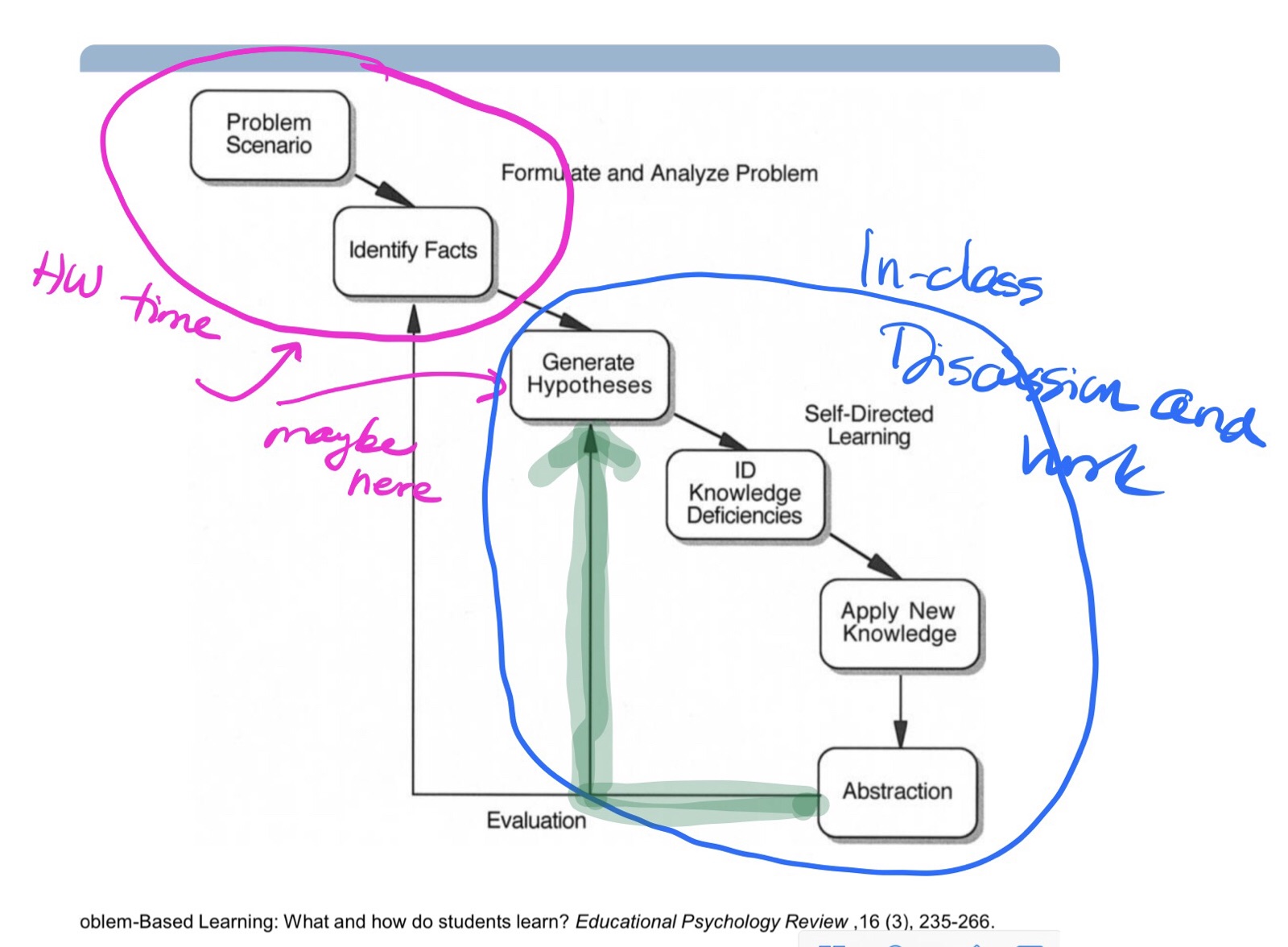
Here’s a diagram that I use when doing PD work with PBL teachers to help explain all of what is supposed to be happening during class (it’s a lot!)


The student presentations are really just a jumping-off point. It is not just for students to explain “how they did a problem” – as they say – or they think what they’re supposed to do. The steps of Hmelo-Silver’s “process of learning in PBL” diagram that I’ve circled in pink is what students would/should do for homework. However, the part that is circled in blue is actually the learning process that happens in the class discussion – so is this time that has been “eaten up” in class or is it actually a very necessary part of the important learning, reflection and self-regulation of the process that needs to happen?

Is this harder for students? Heck, Yeah. There is so much more focus, listening, questioning and reflection that is needed in order for this process to be successful and productive. But there are ways to make it easier for students and that’s what the “class discussion” time is for. It takes a lot of practice and mastery on the teachers’ part to realize what is needed. Making mathematics discussion productive is a very important part of teaching in PBL and definitely not a part that should be seen as subtle, intuitive or straightforward.  There is so much more to this that I can not put in a single blog entry, but it’s definitely worth beginning the discussion.  Would love to hear others’ thoughts.

Modeling with Soap Bubbles

I am so very lucky to have a guest teacher with me this year at my school.  Maria Hernandez (from the North Carolina School of Science and Math) is probably one of the most energetic and knowledgeable teachers, speakers and mathematicians you could ever find – and we got her for the whole year!  We are so excited.  I am working with her and she is so much fun to work with.  I have been teaching calculus with PBL for almost 20 years now and thought I had all the fun I could but no!  Maria is bringing modeling into my curriculum and I’m enjoying every minute of it.

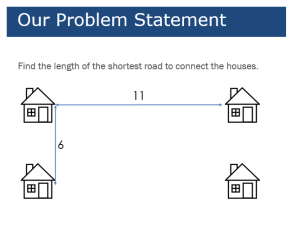
As we started teaching optimization this week, Maria had this wonderful idea that she had done before where we want to find the shortest path that connects four houses.

picture-of-houses

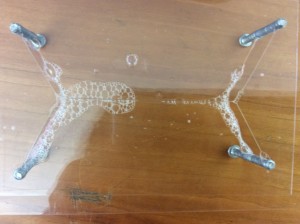
I let the kids play with this for about 10 minutes and then did this wonderful demonstration with some liquid soap bubbles and glycerin.  We had two pieces of plastic and four screws that represented the houses.  As the kids watched, I dipped the plastic frame into the liquid and voila-file_000

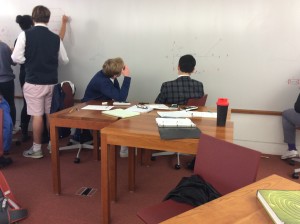
Right away the students saw what they were looking for in the shortest path.  Now they had to come up with the function and do some calculus. As they talked and worked in groups, It was clear that using a variable or one that would help them create the right function was not as easy as they thought.  However,  I was requiring them to write up what they were doing and find a solution so they were working hard.

file_000-1

We have been doing a lot of writing in Calculus this fall so far and they are getting used to being deliberate about their words and articulating their ideas in mathematical ways.

Here is the outline of the work they did in class: Shortest Path Lab

and here is the rubric that I will be using to grade it.

rubric-for-lab-3-2

The engagement of students and the buzz of the classroom was enough to let me know that this type of problem was interesting enough to them – more than the traditional “fold up the sides of the box.”  The experience they had in conjecturing, viewing, writing the algebra and solving with calculus was a true modeling experience.

If you decide to do this problem or have done something like it before, please share – I’d love to do more like this.  I am very lucky to have a live-in PD person with me this year and am grateful every day for Maria!


Being Imaginative in Problem Solving

Sometimes my ignorance with respect to Twitter just floors me. Today alone I made two huge faux pas (is that plural?) with two people that I really respect and just made a fool out of myself – typos, misinterpretations, and misunderstandings abound in my tweets. But I have to say I press on – because I have found so much that informs my teaching and learning that I can handle the fool-making and embarrassment.

So here’s one thing that I did a few weeks ago – someone tweeted about this great article that I, of course, then went and read, took a picture of the great diagram in the article – but forgot to “like” or “favorite” or whatever it’s called now. So now I can’t give credit to whomever brought me to this wonderful enlightenment about which I will now write. So if you are reading, sir/madam, who tweeted this article, please forgive me.

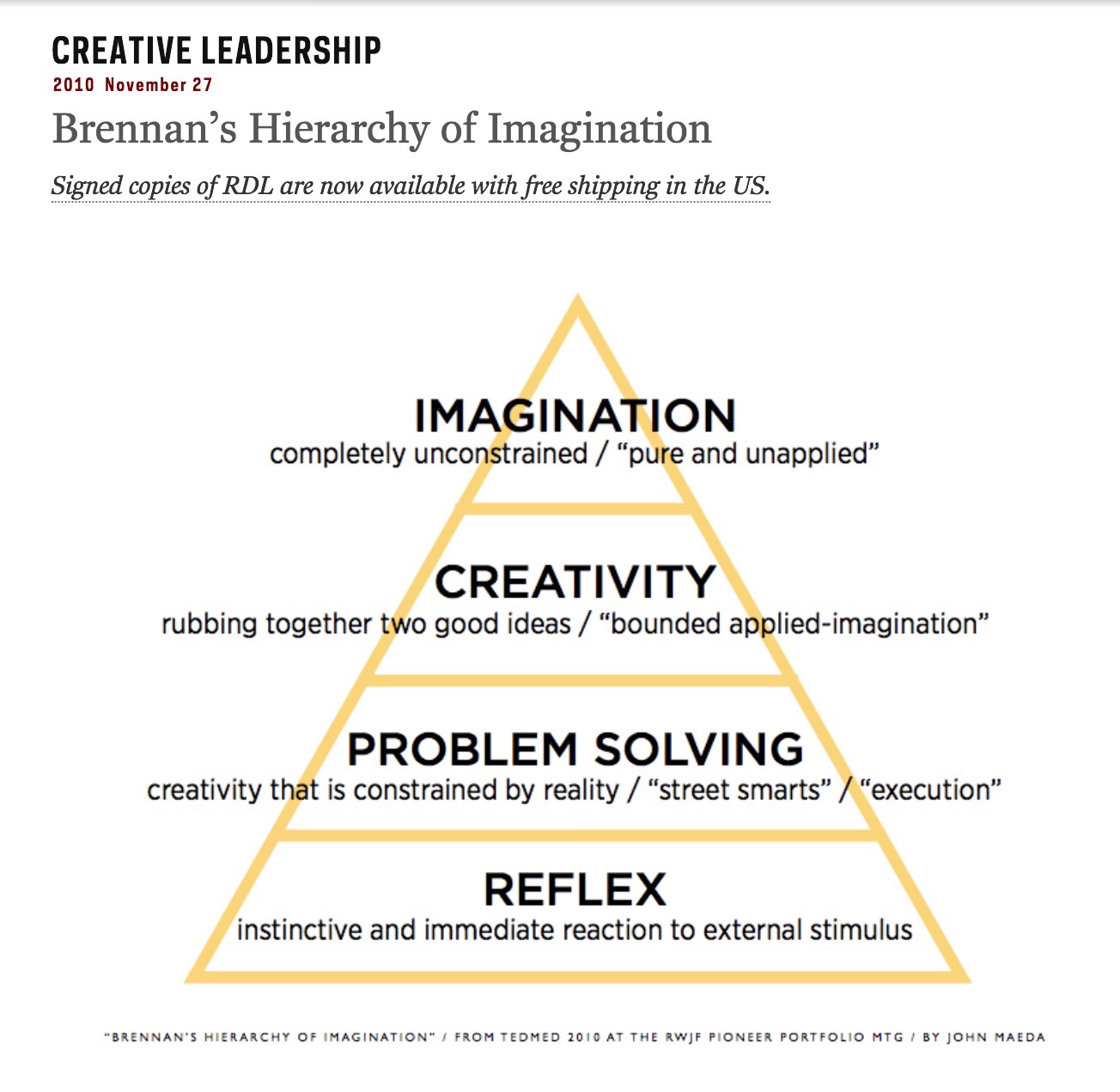
I read this short blogpost entitled “Brennan’s Hierarchy of Imagination” and immediately made the connection to PBL.


The author, John Maeda, wrote about a conversation he had with Patti Brennan about Maslow’s famous Hierarchy of Needs of students in their learning. These two were talking about the fact that teaching creativity is really hard and Patti Brennan was thinking that it was a bit easier to teach someone to use their imagination. She was talking about this in the context of the health care field – trying to help people empower themselves to help themselves.

Of course, the first thing I thought of when I saw this pyramid was problem solving. I thought this was brilliant! The foundational, lower level of reflex or instinct is analogous to doing problems that you have seen before. Students love this instinct – the idea that if you can do a problem that someone has shown you how to do, that you are problem solving, – it gives them a reaction of completing something, some kind of satisfaction.

The next level which is appropriately called problem-solving is when you are actually solving a problem that has occurred but is constrained and you are executing skills. I love this. It still takes some talent and analysis, but you are still just reacting to a given situation. Perhaps putting together two different methods that someone showed you and seeing what happens?

The third level that she calls creativity is the first step to unique ideas and methods. The first attempt at doing something in a different way – saying what if we tried this? Has anyone every done this before? Why not? It’s still bound by the reality that we experience, but seeks to move past the knowledge that we have.

And finally imagination is what I think happens when my 4-year-old niece explains how the clouds got up in the sky because the stars moved so fast pieces came off and clumped together, or when a student can’t figure out if there are more real numbers between 0 and 1 as there are integers and they try to describe the size of those sets to me with things they imagine.

If I’m lucky, I’d say some of the kids in my classes get to creativity – in fact I think that’s been my goal as of late. To get them at least to experience it with some projects, assignments and good problems. To get them to realize that mathematics is more than just a reflex or even just reiterating a process.

Hopefully, this coming year the number of kids who will get to that third level will increase, but who knows? I do love this framework because at least I know I don’t want them stuck on that bottom level for level for long.

Documents for CwiC Sessions at Anja Greer MST Conference 2016

Instead of passing out photocopies, I tried to think of a way that participants could access the “hand-outs” virtually while attending a session.  What I’ve done in the past a conferences is have them just access them on their tablet devices.  You can also go and access copies on the Conference Server if you do not have a device with you (you should be able to use your phone too).

These link to This is an Adobe Acrobat Documentpdf documents that I will refer to in the presentation about “Assessment in PBL”

Information on Spring Term Project and Spring Term Project Varignon 2015 (this document includes rubric)
Keeping a Journal for Math Class
Revised Problem Set Grading Rubric new
Rubric for Sliceform project and Sliceforms Information Packet
Weekly-Learning-Reflection-Sheet

Page at my website with Rubrics and other guides for Assessment

Adventures in Feedback Assessment

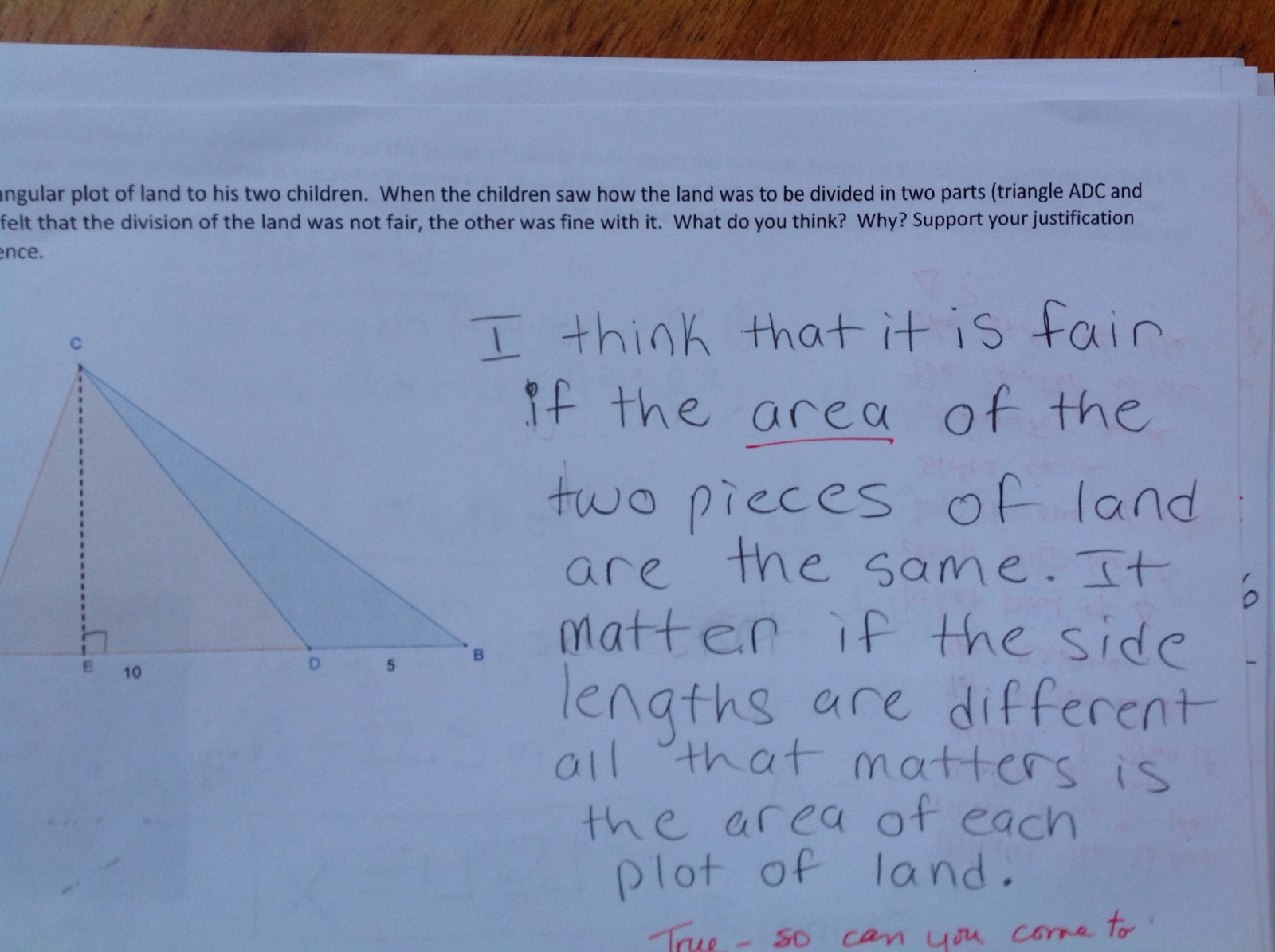
On an assessment students did for me today I gave this question:

An aging father left a triangular plot of land to his two children. When the children saw how the land was to be divided in two parts (Triangle ADC and Triangle BDC), one child felt that the division of the land was not fair, while the other was fine with it. What do you think and why? Support your justification with mathematical evidence.

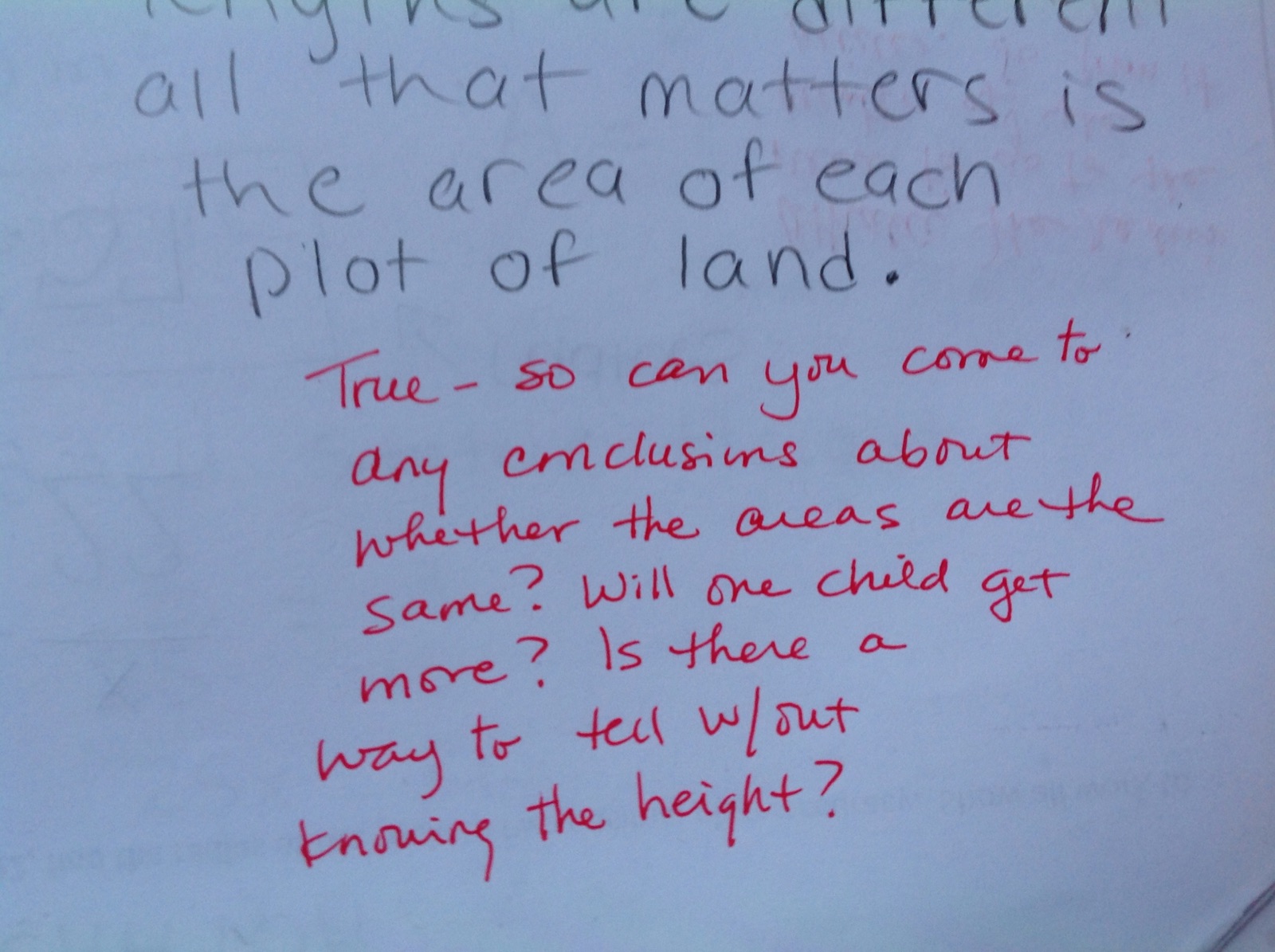
 So this student had a hard time with this question. Since there was no height given and the bases were different, she was unable to think about how to compare the areas. She was however able to say that it would be a fair split if the areas were the same. So since I am doing this work this year with giving feedback first and then grades (see past blogpost “Why teachers don’t give feedback before grades and why they should”) I wrote this feedback on the problem set: 
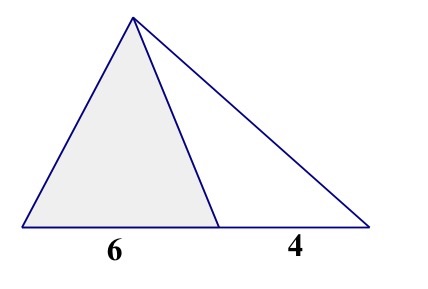
 I am trying to get her to remember a problem we did in class where there was a similar problem we did with an acute triangle and obtuse triangle that shared the same height:

The area of the shaded triangle is 15. Find the area of the unshaded triangle.

This idea of where the height of obtuse triangles are is a really tough one for some geometry students. But more than that the idea of sharing a height and what effect that has on the area is also difficult.

We will see tomorrow if this student is able to take my feedback and see what whether the division of the land is fair.

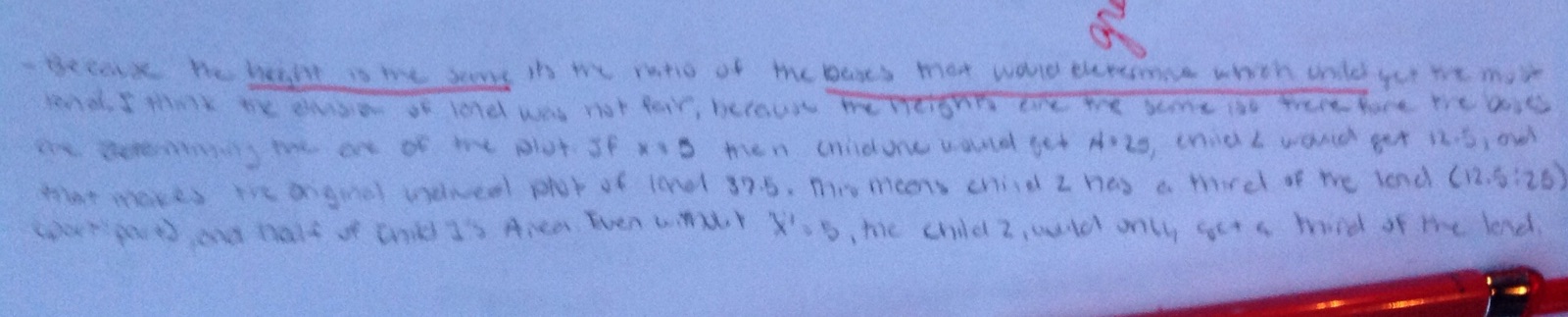
By the way, here’s a response that another student had:


Just in case you can’t read it:

“Because the height is the same, it’s the ratio of the bases that would determine which child would get the most land. I think the division of land was not fair, because the heights are the same so therefore the bases are determining the area of the plot. If x=5 then child one would get A=20, child 2 would get 12.5 and that makes the original plot of land 37.5. This means child 2 has a third of the land (12.5:25) (part:part) and half of child 1’s) Even without x=5, the child 2 would only get a third of the land.”

We’ll see what happens!

Virtual Hand-outs for #GlobalMathDept conference

So tonight I give my very first online talk – I’m a little worried that talking to my computer will be a little strange at 9:00 at night, but we’ll see what happens.  Hopefully, there will be some type of audience interaction.  I’m such a relational person that I think I’m one of those people that really needs feedback will I’m talking.  We’ll see!

My hope is to discuss the differences between PBL & PjBL and how people can find a way to make some type of PBL work in their classroom no matter what place they are at in their teaching.

Here are the documents that I will be mostly referencing.  Hope to see you all there!

Student Self-Report on Class Contribution
Thinking_About_Thinking_Problem_Solving_Tool
Weekly Learning Reflection Sheet
Keeping a Journal for Math Class