One of the Original “Makers”

Apologies to any faithful readers out there – I have had a heck of a summer – way too much going on.  Usually during the summer, I keep up with my blog much more because I am doing such interesting readings and teaching conferences, etc. (although I’m running a conference for the first time in my life!) However, this summer I was dealing with one of my biggest losses – the passing of my father after his 8 year battle with breast cancer.  I thought I would honor him by writing a post talking about a problem that I wrote a few years ago, well actually a series of problems that utilized his work when teachers of algebra I asked me how I taught the concept of slope.  So dad, this one’s for you.

In 1986, my dad, Francesco (Frank) Schettino, was asked to work on the renovations for the centennial project for the Statue of Liberty.  He was a structural steel detailer (also known as a draftsman) but he was really good at his job.  Everywhere we went with my dad when I was younger, he would stop and comment about the way buildings were built or if the structure of some stairs, windows or door frames was out of wack.  He could tell you if something was going to fall down in 10 years, just by looking at it.  At his wake last week, one of the project managers from a steel construction company that he worked on jobs for told me that they would save the interesting, most challenging jobs for him because they knew he would love it and do it right.
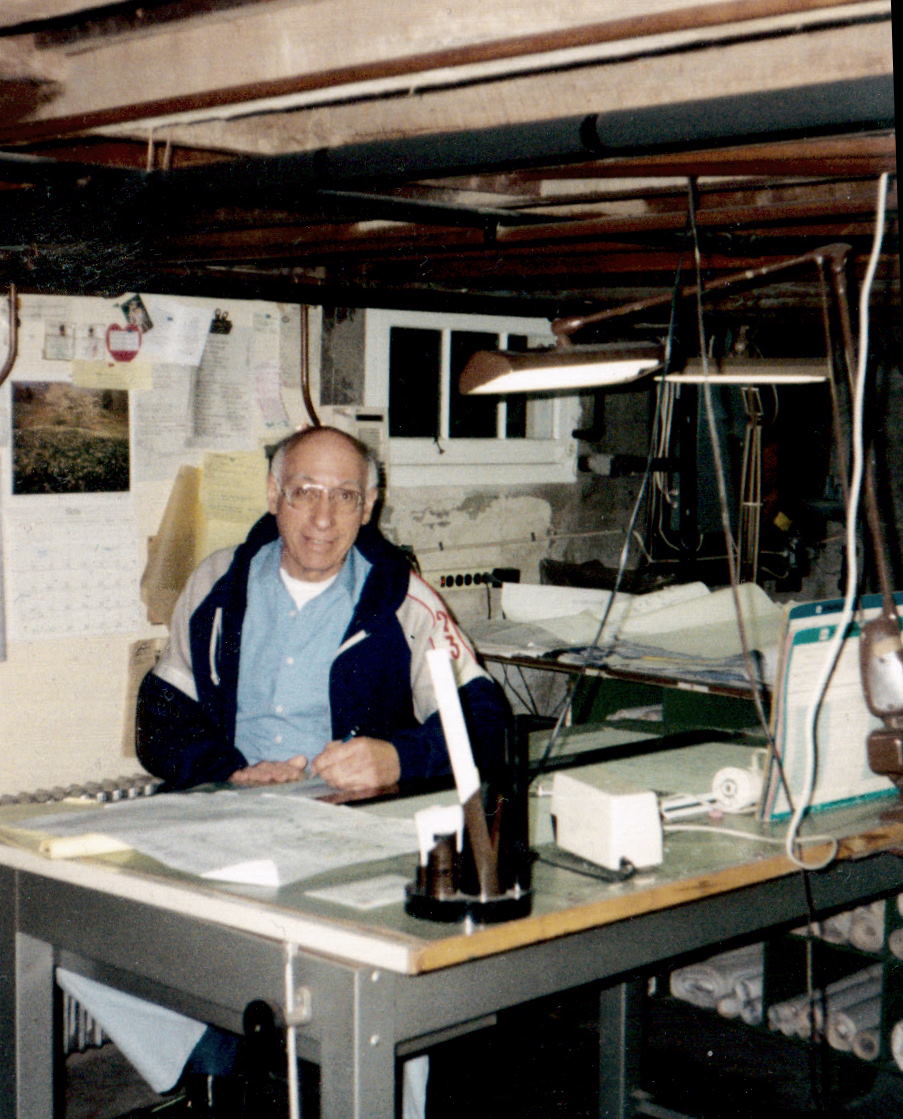
photo (1)I remember sitting with my dad at his huge drafting desk and seeing the drawings of the spiral stairs in the Statue of Liberty.  He talked to me about the trigonometry and the geometry of the circles that were necessary for the widths that were regulated for the number of people that they needed to walk up and down the stairs.  This all blew my mind at the time – that he needed to consider all of this.  So to be able to write problems that introduce slope to students about this was just a bit simpler to me.

If you take a look at my motivational problems on slope and equations of lines I believe it’s numbers 2 and 3 that refer to his work (excuse the small typo).  Over the years I’ve meant to go back and edit these a number of times.  If you are someone who has taken my course at the Anja S. Greer Math, Science and Technology Conference at Exeter, you are probably familiar with this series of questions because we have discussed these at length and talked about how students have reacted to them (and how different adult teacher-students have as well).  We have assumed no prior knowledge of slope (especially the formula) or the terminology at all.

Some questions that have come up: (with both students and the teacher-students I’ve worked with)

1. What does a graphical representation of “stairs” mean to students?
2. What does “steeper” mean and what causes stairs to be steep?
3.  Why are we given the “average” horizontal run for the spiral stairs? Would another measurement be better?
4. Why does the problem ask for the rise/run ratios?  Is there a better way to measure steepness?
5. (from a teacher perspective) why introduce the term “slope” in #3? can we just keep calling it steepness?

These are such rich and interesting questions. The questions of scaffolding terminology and when and how to introduce concepts are always the most difficult.  Those we grapple with specifically for our own students.  I always err on the side of allowing them to keep calling it steepness as long as they want, but as soon as we need to start generalizing to the abstract idea of the equation of the line or coming up with how to calculate that “steepness” a common language of mathematics will be necessary.  This is also where I take a lesson from my dad in terms of my teaching.  His great parenting style was to listen to me and my sisters and see where we were at – how much did we know about a certain situation and how we were going to handle it.  If he felt like we knew what we were doing, he might wait and see how it turned out instead of jumping in and giving advice.  However, if he was really worried about what was going to happen, he wouldn’t hesitate to say something like “Well, I don’t know…”  His subtle concern but growing wisdom always let us know that there was something wrong in our logic but that he also trusted us to think things through – but we knew that he was always there to support and guide.  There’s definitely been a bit of his influence in my career and maybe now in yours too.
TeachThought Blogging Challenge Day1: Goals for this Year

 OK, so I’ve decided to try to blog more this coming year (like I don’t have anything else to do working at a boarding school) and I happened to run across the TeachThought Blogging Challenge the other day, so I thought I would try to see how many of the 30 days, I might be able to actually write something that was worthwhile.
 
 I even downloaded a new app for my iPad to make blogging easier (we’ll see if that prediction comes true or not) called BlogPress which had some really nice reviews. (Using it right now, with a little help from my java programming husband).
 
 So Day 1 assignment is to “Write your goals for the school year. Be as specific or abstract as you’d like to be.” This is quite an overwhelming task honestly, there are often so many of them. So after some thought I came up with three and here they are:
 
 1. I am mentoring a teaching fellow in my department this year and so one of my goals this year is to be a good mentor. I know that’s pretty abstract but when you have another teacher’s success or failure connected to how well you discuss teaching, mathematics and learning with that person I find the overall goal pretty important. Mentoring someone in PBL is even trickier if it’s their first time teaching and they haven’t actually seen it in action yet. From doing this in the past, I know I also have to find ways to allow young teachers to express their hesitation and doubts with this method of teaching, so being aware of the discussion and keeping the dialogue open will parts of being a good mentor.
 
 2. My second goal is to work on assessing student learning through listening. One of the biggest issues I am grappling with in the classroom and have thought about a great deal in PBL, is how well students can learn from each other by listening to discussion. In fact, I know that one of the biggest arguments that “doubters” have with PBL is that if students are not just told what the important facts are and given clear instruction (what to learn when) learning can’t happen. I want to find ways in which to assess how well students are learning through dialogue. This was inspired when I heard a talk a year or so ago by Karl Kosko (Kent State University) about a study he did related to student listening and their learning. If I remember correctly there was a direct relationship between how well a student could articulate their ideas during a conversation and how well they listened. (So talking and listening are connected.)
 
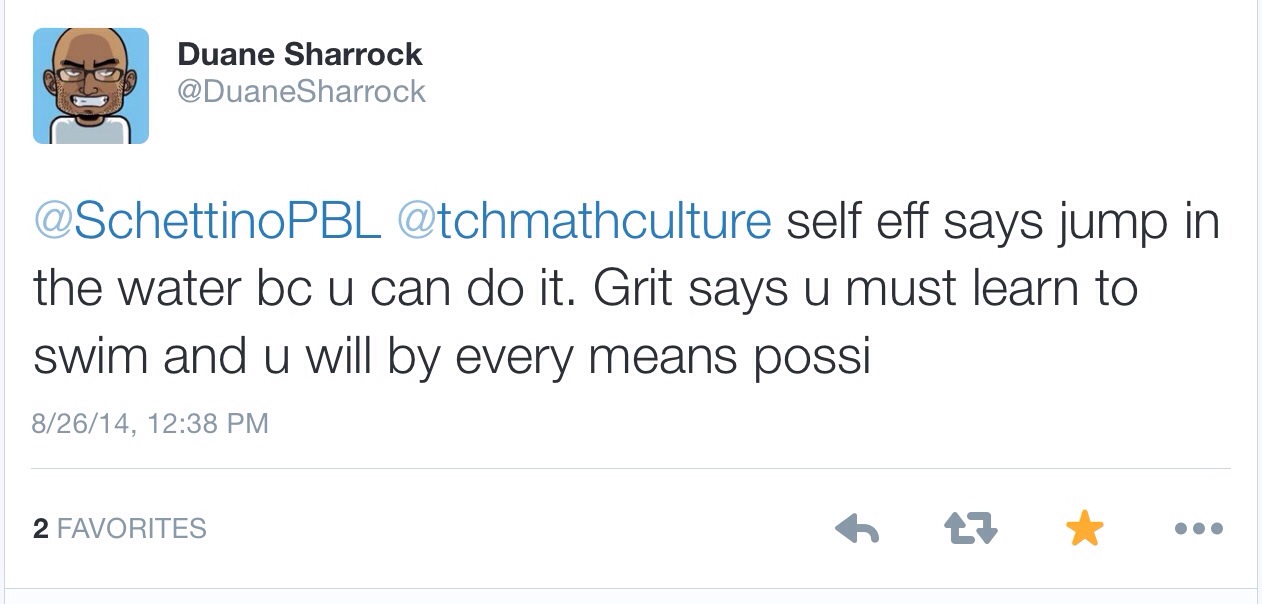
 3. My third goal is to think about the connections between PBL and grit or self-efficacy. I gave a lot of thought this summer to the differences between grit and self-efficacy and I think one of the best differences I found was tweeted by a guy named Duane Sharrock (@DuaneSharrock) when he responded to request for any distinctions that people had in a tweet I put out there. He said:


So in my mind it seems like Self-Efficacy has more to do with confidence and self-attribution of skills and Grit might have more to do with persistence and determination. I am actually interested in both with respect to what PBL fosters in students. To that end, I am going to do a lot of reading and research to see what’s out there and would love to hear from any readers if you have thoughts or experiences with this.
 
 There are my three main goals for the year. My classes start on Friday, but tomorrow they all arrive – wish me luck! Good luck to all of you out there!

What does “making students metacognitive” mean? – answering “why should someone learn?” in Math

So I recently tweeted a nice article that I read that discussed “12 Questions to Help Students See Themselves as Thinkers” in the classroom (not specifically the math classroom


and appropriately, Anna Blinstein tweeted in response:


So I thought I needed to respond in a post that spoke to this question. First of all, I should state the caveat that even when I am in a more “standard” classroom (i.e. not a PBL classroom) – which happened to me last year – I try as much as possible to keep my pedagogy consistent with my values of PBL which include

1) valuing student voice
2) connecting the curriculum
3) dissolving the authoritative hierarchy of the classroom
4) creating ownership of the material for students

I find that helping students to be metacognitive helps with all of this. An important aside her is also Muller’s definition of 21st century learning* which is much more than that 20th century learning and education that often comes with direct instruction in the mathematics classroom (not always).I think it’s important to note that the more fluid concept of knowledge that is ubiquitous with technology today and is no longer static in textbooks or delivered by teachers.  Students can go find out how to do anything (procedurally) nowadays, but it is the understanding of it that is more important and the true mathematical learning and sense making.

Anyway, I think I would write way too much if I responded to every one of the questions, but how would I use these questions in my direct instruction class that I taught last year?  What I tried to do was introduce a topic with some problems (and then we would do some practice with problems from the textbook so I could keep up with where my colleague was in the material).  Well, this course was Algebra II, which often referred to prior knowledge that always reminded students of something they had studied before.  I let them use computers to look things up on the internet and use the technology at hand, GeoGebra, Graphing Calculators, each other to ask questions about the functions we were studying.  They could look up topics like domain, range, asymptotes (why would there be an asymptote on a rational function)…but then the bigger questions like “what am I curious about?” had more to do with how did those asymptotes occur, what made vertical vs. horizontal asymptotes and then I would have them do journal entries about them (see my blogposts on metacognitive journaling – journaling and resilience, using journal writing, page on metacognitive journaling).

The more “big picture” questions like “Why learn?” and “What does one *do* with knowledge?” I find easier to deal with because the students ask those.  I think that all teachers find their own ways to deal with them, but I enjoy doing is asking students about a tough question they are dealing with in their life – I use the example of whether or not I should continue working when I had my two kids.  Was keeping my job worth it financially over the cost of daycare? and of course I had to weight my emotional state when I wasn’t working – this is why I enjoy learning and what I do with my knowledge.  When kids see that there’s more to do with functions than just points on a grid, it becomes so much clearer for them – but you know that!

What I really like about Dr. Muller’s list is that he lays out some nice deliberate ways in which we as math teachers can get students to think more clearly and reflectively about mathematics as a purposeful process as opposed to a just procedures that they can learn by just watching a Kahn Academy video.


*”Learning – here defined as the overall effect of incrementally acquiring, synthesizing, and applying information – changes beliefs. Awareness leads to thoughts, thoughts lead to emotions, and emotions lead to behavior. Learning, therefore, results in both personal and social change through self-knowledge and healthy interdependence.” Muller http://tutoringtoexcellence.blogspot.com/2014/08/helping-students-see-themselves-as.html

Sharing in Chicago! PME-NA 2013

So tomorrow I’m off to PME-NA 2013 in Chicago which is one of my most favorite conferences for mathematics education research.  I will be presenting my research findings from my dissertation on Saturday morning and I’m so lucky to be going.  I’ve posted my PMENA handout  for anyone interested in having it.  I’m also posting  the powerpoint on my slideshare site.

Buyer Beware…when using rubrics for critical thinking skills

One of my goals in my work is often to help classroom mathematics teachers to be more deliberate in the ways in which they assess problem solving.  Although many people can be cynical about rubrics, I think that students can find them at least helpful to know what a teacher expects of them.  I have some students who told me that they pull out my rubric for grading journal writing almost every time they go to write a journal entry this fall.

However, a rubric that is vague and ambiguous about expectations can cause more harm than good.  Just throwing a rubric around that students can look at, or one that you can post on your website that you can show an administrator and say, “See, I have a rubric for that” isn’t necessarily a good thing.  Especially for problem solving.  Problem solving as a process is a very difficult thing to nail down for students especially in terms of the levels of how they can improve in their work.

I recently ran across this rubric that posted on a website under the title “Awesome Problem Solving Rubric for Teachers.”

Is this an “Awesome Rubric” for teachers?

As I read through this, at first glance the categories look pretty good – Identify the problem, identify relevant information, analyze the problem, use strategies and reflect on the process.  Sounds like a pretty standard problem solving process –very similar in many ways to Polya’s process or the steps that Jo Boaler discussed in her online course How to Learn Math this summer.

The graded level descriptors of how a student might be able to see where their work “fits” in the rubric seems to only put the behaviors on a “continuum” of Always- sometimes- never instead of trying to describe actions that the student could do that describe a mediocre way of using a strategy.    For example, analyzing a problem can be so much more descriptive than just “I think carefully” about the problem before a student starts.

They could:

1. listen deliberately to others’ ideas and reflect on them in writing or verbally

2. question the given information of a problem – does it make sense in a realistic way?

3. think about the representations they can come up with for the problem – does a graphical approach make the most sense?  Why?  Would making a geometric representation be better, if so why?

4.  In comparing a new problem to ones I’ve already done, can I list the similarities and differences?  What is this question asking that others I’ve done not asked?

How many students can really ascertain what “thinking carefully” about a problem is?  I have found that more and more we need to erase as much ambiguity as possible to help students learn to be critical thinkers.  As we feel the need to teach critical thinking, reasoning skills and sense making, it is even more imperative to have rubrics that are as precise as possible.

Now, I don’t claim that mine are perfect, but my rubrics and student feedback forms have gotten some pretty good reviews from teachers and successful feedback from students.  I work on them every summer and am continually editing in order to be more deliberate about the feedback I give my students.

I also highly recommend the rubrics from the Buck Institute Website under their “tools” category.  I also adapted one of their critical thinking rubrics that was aligned to the Common Core and changed it directly for my PBL curriculum – more for presentation of problems and novel problem solving.  I’m still working on it because I have to think about exemplars for what would be above standards, but let me know if you have any feedback.

Critical Thinking rubric for PBL

So, I would just warn anyone to beware of “awesome rubrics” for teachers that they find on the internet because something that might seem awesome at first glance might end up doing more harm than good.

Minimizing Shame in the PBL Classroom…and maybe Daring Greatly?

I recently read a blogpost by one of my favorite authors, Brene Brown, of TED talk fame, and the author of a great book about vulnerability called Daring GreatlyIn her blogpost Brene wrote about some reactions to a comment she made on Oprah Winfrey’s Super Soul Sunday show where she talked about shame in schools about which she received a great deal of criticism in the blogosphere and on twitter.

I kept reading as I was shocked that anyone would be offended by anything that Brene Brown could say – especially teachers.  She has always been extremely inspiring and very supportive of teachers – as a teacher herself, her book, Daring Greatly, has a whole chapter on how schools can support a community to come together around vulnerability and become closer and foster creativity and innovation in this way.

However, she talks about the research that she has done about learning and teaching.  She says,

“As a researcher, I do believe that shame is present in every school and in every classroom. As long as people are hardwired for connection, the fear of disconnection (aka shame) will always be a reality. ..Based on my work, I do believe that shame is still one of the most popular classroom management tools.”

Think about it.  When you talk to adults about their memories of school, and specifically math classrooms, many people will tell stories of being embarrassed or humiliated about getting something wrong, about feeling less than adequate or unworthy of being in the class they were in.  Even if the teacher was not doing anything deliberate, if a student has the courage to answer a teacher initiated question and get it wrong, the response that is given can make or break their self-worth that day.

I’ve been giving this a lot of thought in the context of the PBL Classroom – How are we supposed to be teaching students how to take risks and not be afraid to be wrong and make mistakes in their learning if they have this fear of shame that is so deeply entrenched in our culture?  Especially in mathematics classrooms, how are we supposed to undo so many negative experiences that may have affected a student’s ability to allow themselves to be vulnerable and learn in this way?

PBL relies on the fact that a student is willing and able to make connections and conjecture regularly – numerous times in a class and on their own during “homework” time.  Being wrong and uncertain is really the norm and not the anomaly in this classroom.  As October rolls around and I hear more from students (and parents) about the discomfort they are feeling, I really do understand how different this is for everyone.  However, I do think we need to rely on the fact that students can be resilient and strong when pushed to try new things and to learn in a way that is good for them.  It is just that resilience that will make them better leaders, learners and more creative in the work force later on in life.

In talking to some students recently, I asked them where they thought they would learn more, in a classroom where it was laid out for them what they had to do or where they had to make choices about methods and sometimes it would be unclear.  I could tell that one girl was really struggling with that question.  She knew that it would be easier in the other classroom, but also knew that she would learn more and wanted to stay where her learning would be more effective.

What can I do to help this process go more smoothly?  Make sure that they know that I am working hard NOT to use shame as a classroom management tool.  That I am sincerely interested in the mistakes that they are making and how it is helping their learning.  I want them to grow from their errors and misconceptions and find ways to use those to their advantage.  I want to add to their self-worth not only as a math student, but as a problem solver in every way.

As Brene Brown says:

“I don’t believe shame-free exists but I do believe shame-resilience exists and that there are teachers creating worthiness-validating, daring classrooms every single today.”

I can be truly aware of the language that I use and the questions that I ask in order to make sure that everyone’s voice is heard and that my students know that I want to hear their ideas.  It’s really the only way to get them to Dare Greatly!

PS – Check out the wonderful quote by Teddy Roosevelt that I use in my PBL classes about Daring Greatly that Brene Brown used for the title of her book.

Anja S. Greer Conference 2013

What a great time we had this week in my courses!  I am so excited by all of the folks that I met and the CwiC sessions of other leaders that I went to.  Pretty awesome stuff presented by Maria Hernandez from NCSSM, my great colleague Nils Ahbel, Tom Reardon, Ian Winokur, Dan Teague, Ken Collins and many others.  I was so busy that I didn’t get to see many other people’s sessions so I feel somewhat “out of it” unfortunately.

I want to thank everyone that came to my CwiC’s and remind them to be sure to go and pick up my materials on the server before they leave.

For my participants – here are the links to the course evaluations:

Moving Forward with PBL: Course Evaluation

Scaffolding and Developing a PBL Course:  Course Evaluation

Defying Gravity as a Means to Learning from Mistakes

There’s a lot of blogging, writing and research (and anecdotal stories) out there these days about trying to foster the value in students for the appreciation in failing.   I even wrote a blog entry two years ago entitled “modeling proper mistake-making” way before I read anything or watched any videos on the Internet.  From teaching with PBL for over 17 years, I am a pro at making mistakes and watching students struggle with the concept of accepting the idea of learning from their mistakes.  This is so much easier said than done, but it is clearly something that grow to love even if only for a short time.

Last April, I had the pleasure of hearing Ed Burger at the NCTM national conference where he spoke about having students in his college-level classes required to fail before they could earn an A in his class.  In his August 2012 essay “Teaching to Fail” from Inside Higher Ed (posted at 3:00 am, which I thought was kind of funny), he talks about attempting to make a rubric for the “quality of failure” on how well a student had failed at a task.  I thought this was an interesting concept.  I mean, in order to fail well, can’t you just really screw up, like not do it at all?  Prof. Burger states that allowing students to freely reflect on their “false starts and fruitful iterations” as well as how their understanding “evolved through the failures” can be extremely beneficial.  He also states:

“To my skeptical colleagues who wonder if this grading scheme can be exploited as a loophole to reward unprepared students, I remind them that we should not create policies in the academy that police students, instead we should create policies that add pedagogical value and create educational opportunity.”

Last year for the first time, I tried a similar experiment wherein I gave students an assignment to write a paper in my honors geometry class.  They had to choose from three theorems that we were not going to prove in class.  However, it was clear that they could obviously just look up the proof on the Internet or in a textbook or somewhere, since they clearly have been proven before.  The proof was only 10 or 20% of their grade.  The majority of the paper’s grade was writing up the trials and failures in writing the proof themselves.  This proved to be one of the most exciting projects of the year and the students ate it up.  I even told them that I didn’t care if they looked up the proof as long as they cited it, but I still had kids coming to me to show my how they were failing because they wanted a hint in order to figure it out themselves.  It was amazing.

This past week I showed my classes Kathryn Schultz’ TED talk entitled “On Being Wrong” in which she talked about the ever popular dilemma of the Coyote who chases the Road Runner, usually off a cliff.

My students loved her analogy of the “feeling of being wrong” to when the Coyote runs off the cliff and then looks down and of course, has to fall in order to be in agreement with the laws of gravity.  However, I proposed a different imaginary circumstance.  Wouldn’t it be great if we could run off the cliff, i.e. take that risk, and before looking down and realizing that vulnerability and scariness, just run right back on and do something else?  No falling, no one gets hurt, no one looks stupid because you get flattened when you hit the ground?  Maybe that’s not the “feeling of being wrong” but it’s the “feeling of learning.”

Next blog entry on creating the classroom culture for “defying gravity.”

Some (hopefully) helpful Mobile Technology (i.e. iPad) information

This past week I spoke with many teachers who are being asked to implement an iPad program in their schools this coming year and feel as though they are lost in the woods. Although their schools are doing what they can to support math teachers in their endeavors, the truth is that the “mobile technology of the future” (i.e. the direction that most technology coordinators say that education is moving) really has not caught up with the needs of mathematics educators. In a presentation I gave last week, I made the distinction between three different types of apps that exist out there for math teachers to use. I believe that the “tool apps” are useful when you want the mobile device to replace an actual tool or a skill that students have learned or that you feel can be replaced but a short cut. Great examples of these are ruler or protractor apps. However, beware of apps that are tools for doing the quadratic formula – just pop in a, b, and c and 30 “practice” problems can be done in 5 minutes (although I could go off on having students do 30 of the same type of problem for homework too). These apps are not necessarily made to aid in the process of learning for students.

Secondly, there are the “review apps” – the ones that are created to help students prepare for standardized tests, name all the theorems in geometry from A to Z, list all the possible types of polygons and their interior angles, etc. These are helpful apps for reference once a student has learned the material and for reviewing for end of year exams, etc. However, once again they do not necessarily aid in the learning of the material.

The third kind of app is what I was truly looking for – these “teaching apps” are really “understanding apps.” They make the process of understanding a concept or whatever is going on in the classroom more productive, efficient, interesting or engaging. I have to say that sadly, these apps are far and few between. I have surfed many a math app blog on the internet and there is no distinction between these three categories and in my mind, teachers want a distinction. Many of the ratings in the iTunes store are made by students so I recommend reading the review and if it says something like “This app is great. It let me do my homework in 5 minutes” (5 stars), my guess is it’s not necessarily the app you are looking for. Here is the list of apps I gave out at my CwiC session that I found useful and within this third categories of math education apps.

The last thing I had to comment on was the fact that the iPad (and mobile devices in general) have a way to go before they catch up with the old Tablet PC when it comes to digital ink. Writing, for a mathematics teacher, is still the easiest way to put equations into lesson plans, tests, board presentations, problems, correcting papers, etc. So although we are not artists looking for the best stylus for drawing or sketching, we actually do drawing and sketching. We are not business-people who take notes during hugely important meeting with clients, but it still is annoying when your stylus makes noise on the glass screen in a meeting with administrators or even in class with students. And having a wrist guard or palm protector that actually works (and doesn’t make the screen move or leave marks) in the note-taking app, is extremely important to us. We also need drawing tools like geometry shapes, coordinate axes, and hopefully (dare I ask) access to symbolic text, like Greek letters.

At the conference I got into a great conversation with some teachers about different styli and which were the best. I found a Great Stylus Video Review online that I highly recommend if you are looking for a new stylus for your mobile device for writing or doing mathematics. I think I might actually order the Maglus from overseas to see how good it is.

Keep in touch about the mobile apps you are using, cause I’d love to hear about them. I do believe that someday the devices and their technology will catch up with the needs of math teachers, but for now, I sort of miss my Tablet PC and OneNote for writing – 🙁 But I am loving playing with all these new apps. I’m like a kid in a candy store, but hopefully more productive.