PBL – Students making Mathematical Connections

As someone who has used Problem-Based Learning for almost 20 years and sad to say has never been part of a full-fledged Project-Based Learning curriculum, what I know best is what I call PBL (Problem-Based Learning).  I know there is a lot of confusion out there is the blogosphere about what is what, and with which acronyms people use for each type of curriculum.  I did see that some people have been trying to use PrBL for one and PBL for the other, but I guess I don’t see how that clarifies – sorry.

So when I use the acronym PBL in my writing I mean Problem-Based Learning and my definition of Problem-Based Learning is very specific because it not only implies a type of curriculum but an intentional relational pedagogy that I believe is needed to support learning:

Problem-Based Learning (Schettino, 2011) – An approach to curriculum and pedagogy where student learning and content material are (co)-constructed by students and teachers through mostly contextually-based problems in a discussion-based classroom where student voice, experience, and prior knowledge are valued in a non-hierarchical environment utilizing a relational pedagogy.

Educational Psychologist and Cognitive Psychologists like Hmelo-Silver at Rutgers University have done a lot of research on how students learn through this type of scaffolded problem-based curriculum dependent on tapping into and accessing prior knowledge in order to move on and construct new knowledge.  There was a great pair of articles back in 2006/2007 where Kirschner, Sweller & Clark spoke out against problem- and inquiry-based methods of instruction and Hmelo, Duncan and Chinn responded in favor.  I highly recommend reading these research reports for anyone who is thinking of using PBL or any type of inquiry-based instruction (in math or any discipline).  It really helps you to understand the pros and cons and parent and administrator concerns.

However, after you are prepared and know the score, teachers always go back to their gut and know what works for their intuitive feeling on student learning as well.  For me, in PBL, I look at how their prior knowledge connects with how, why and what they are currently learning.  One of the best examples of this for me is a sequence of problems in the curriculum that I use which is an adaption from the Phillips Exeter Academy Math 2 materials.  I’ve added a few more scaffolding problems (see revised materials) in there in order to make some of the topics a bit fuller, but they did a wonderful job (which I was lucky enough to help with)and keep adding and editing every year. The sequence starts with a problem that could be any circumcenter problem in any textbook where students use their prior knowledge of how to find a circumcenter using perpendicular bisectors.

“Find the center of the circumscribed circle of the triangle with vertices (3,1), (1,3) and (-1,-3).”

Students can actually use any method they like – they can use the old reliable algebra by finding midpoints, opposite reciprocal slopes and write equations of lines and find the intersection points.  However, I’ve had some students just plot the points on GeoGebra and use the circumcenter tool.  The point of this problem is for them to just review the idea and recall what makes it the circumcenter.  In the discussion of this problem at least one students (usually more than one) notices that the triangle is a right triangle and says something like “oh yeah, when we did this before we said that when it’s an acute triangle the circumcenter is inside and when it’s an obtuse triangle the circumcenter is outside.  But when it’s a right triangle, the circumcenter is on the hypotenuse.”

Of course then the kid of did the problem on geogebra will say something like, “well it’s not just on the hypotenuse it’s at the midpoint.”
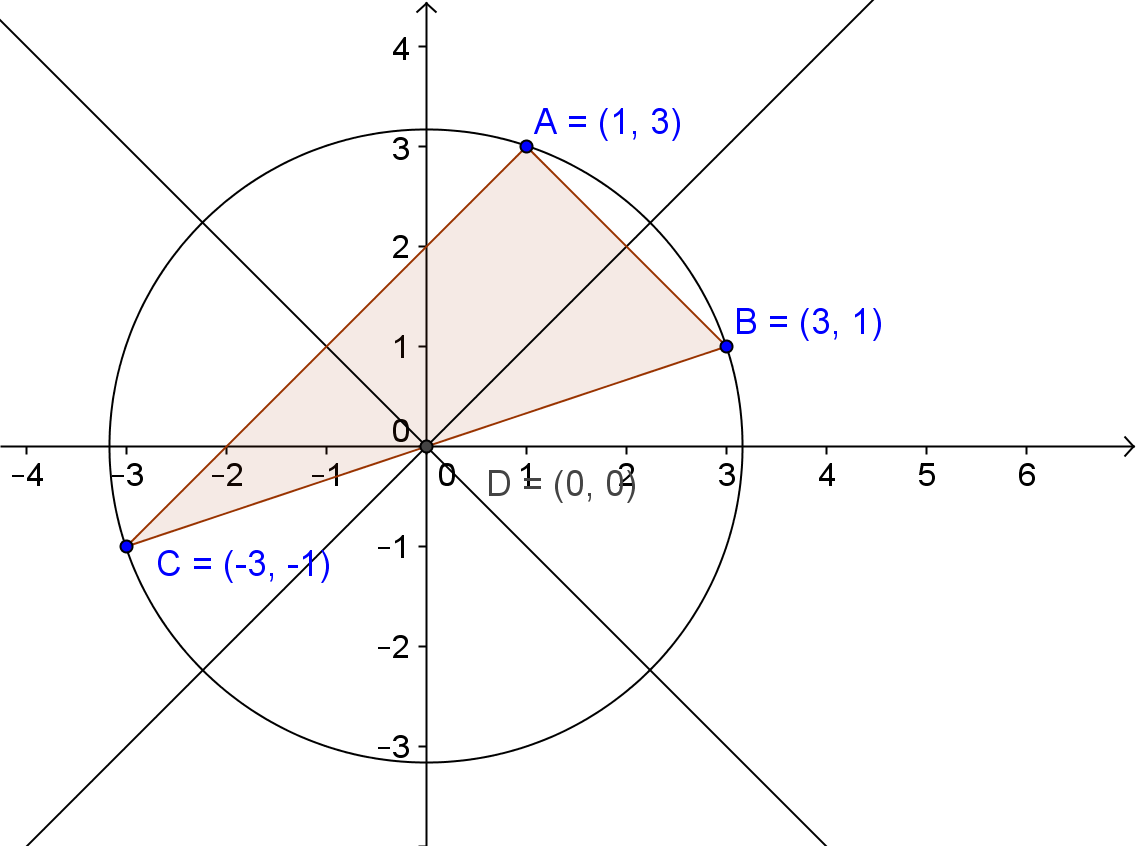
 

Dicussion will ensue about how we proved that the circumcenter of a right triangle has to be at the midpoint of the hypotenuse.

A day or so later, maybe on the next page there will be a problem that says something like

“Find the radius of the smallest circle that surrounds a 5 by 12 rectangle?”

Here the kids are puzzled because there is no mention of a circumcenter or triangle or coordinates, but many kids start by drawing a picture and thinking out loud about putting a circle around the rectangle and seeing they can find out how small a circle they can make and where the radius would be.  When working together oftentimes a student see a right triangle in the rectangle and makes the connection with the circumcenter.

A further scaffolded problem then follows:

“The line y=x+2 intersects the circle  in two points.  Call the third quadrant point R and the first quadrant point E and find their coordinates.  Let D be the point where the line through R and the center of the circle intersects the circle again.  The chord DR is an example of a diameter.   Show that RED is a right triangle.”
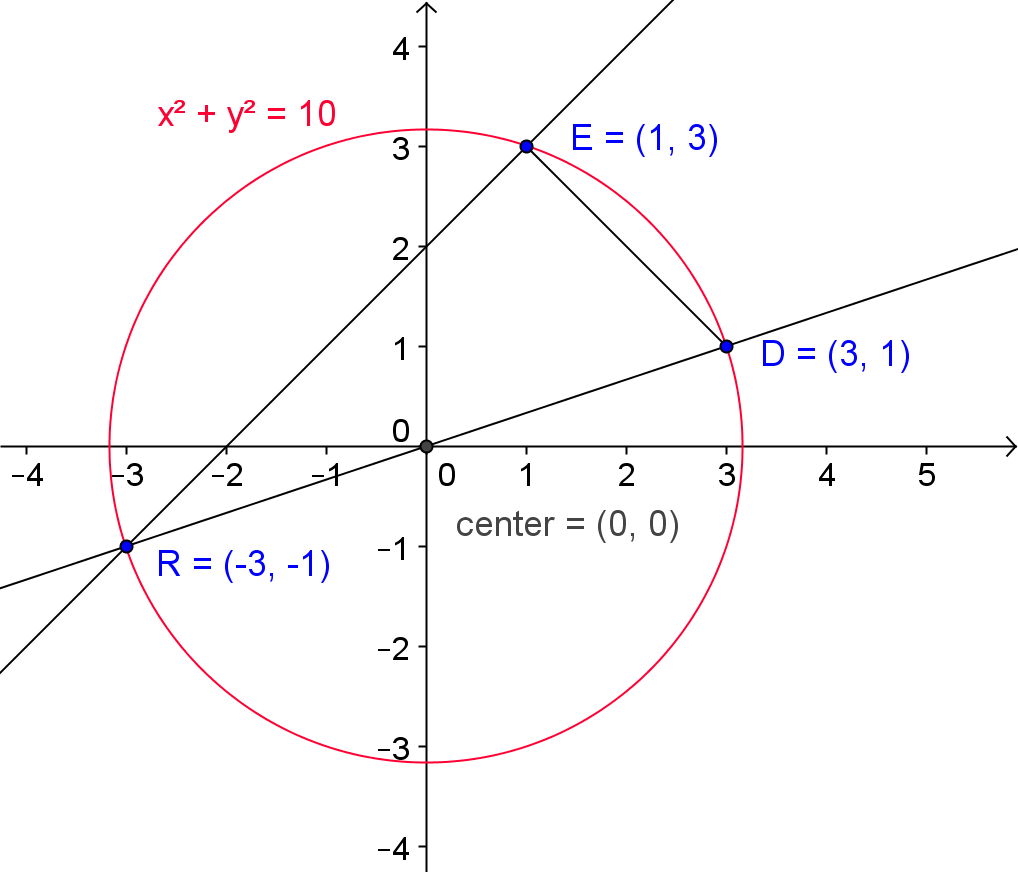
Inevitably students use their prior knowledge of opposite reciprocal slope or the Pythagorean theorem.  However, there may be one or two students who remember the circumcenter concept and say, “Hey the center of the circle is on one of the sides of the triangle.  Doesn’t that mean that it has to be a right triangle?”  and the creates quite a stir (and an awesome “light bulb” affect if I may say so myself).

A few pages later, we discuss what I like to call the “Star Trek Theorem” a.k.a. the Inscribed angle theorem (I have a little extra affection for those kids who know right away why I call it the Star Trek Theorem…)
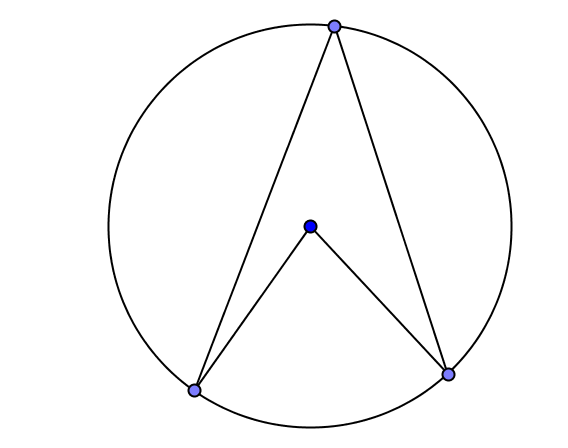
I will always attempt to revisit the “RED” triangle problem after we discuss this theorem.  If I’m lucky a student will notice and say, “Hey that’s another reason it’s a right triangle – that angle opens up to a 180 degree arc, so it has to be 90.”  and then some kid will say “whoa, there’s so many reasons why that triangle has to be a right triangle”  and I will usually ask something like, “yeah, which one do you like the best?” and we’ll have a great debate about which of the justifications of why a triangle inscribed in a circle with a side that’s a diameter has to be right.  So who are the bigger geeks, their teacher who names a theorem after Star Trek or them?

References:

Kirschner, P. A., Sweller, J., & Clark, R. E. (2006). Why minimal guidance during instruction does not work: An analysis of the failure of constructivist, discovery, problem-based, experiential and inquiry-based teaching. Educational Psychologist, 41(2), 75-86.


Hmelo, C. E., Duncan., R.G., & Chinn, C. A. (2007). Scaffolding and achievement in problem-based and inquiry learning: A response to Kirschner, Sweller and Clark (2006). Educational Psychologist, 42(2), 99-107.
 

Defying Gravity as a Means to Learning from Mistakes

There’s a lot of blogging, writing and research (and anecdotal stories) out there these days about trying to foster the value in students for the appreciation in failing.   I even wrote a blog entry two years ago entitled “modeling proper mistake-making” way before I read anything or watched any videos on the Internet.  From teaching with PBL for over 17 years, I am a pro at making mistakes and watching students struggle with the concept of accepting the idea of learning from their mistakes.  This is so much easier said than done, but it is clearly something that grow to love even if only for a short time.

Last April, I had the pleasure of hearing Ed Burger at the NCTM national conference where he spoke about having students in his college-level classes required to fail before they could earn an A in his class.  In his August 2012 essay “Teaching to Fail” from Inside Higher Ed (posted at 3:00 am, which I thought was kind of funny), he talks about attempting to make a rubric for the “quality of failure” on how well a student had failed at a task.  I thought this was an interesting concept.  I mean, in order to fail well, can’t you just really screw up, like not do it at all?  Prof. Burger states that allowing students to freely reflect on their “false starts and fruitful iterations” as well as how their understanding “evolved through the failures” can be extremely beneficial.  He also states:

“To my skeptical colleagues who wonder if this grading scheme can be exploited as a loophole to reward unprepared students, I remind them that we should not create policies in the academy that police students, instead we should create policies that add pedagogical value and create educational opportunity.”

Last year for the first time, I tried a similar experiment wherein I gave students an assignment to write a paper in my honors geometry class.  They had to choose from three theorems that we were not going to prove in class.  However, it was clear that they could obviously just look up the proof on the Internet or in a textbook or somewhere, since they clearly have been proven before.  The proof was only 10 or 20% of their grade.  The majority of the paper’s grade was writing up the trials and failures in writing the proof themselves.  This proved to be one of the most exciting projects of the year and the students ate it up.  I even told them that I didn’t care if they looked up the proof as long as they cited it, but I still had kids coming to me to show my how they were failing because they wanted a hint in order to figure it out themselves.  It was amazing.

This past week I showed my classes Kathryn Schultz’ TED talk entitled “On Being Wrong” in which she talked about the ever popular dilemma of the Coyote who chases the Road Runner, usually off a cliff.

My students loved her analogy of the “feeling of being wrong” to when the Coyote runs off the cliff and then looks down and of course, has to fall in order to be in agreement with the laws of gravity.  However, I proposed a different imaginary circumstance.  Wouldn’t it be great if we could run off the cliff, i.e. take that risk, and before looking down and realizing that vulnerability and scariness, just run right back on and do something else?  No falling, no one gets hurt, no one looks stupid because you get flattened when you hit the ground?  Maybe that’s not the “feeling of being wrong” but it’s the “feeling of learning.”

Next blog entry on creating the classroom culture for “defying gravity.”

Doing What You Can

I just got back from a great visit to Toronto (which was also my first visit to that wonderful city.)  I spoke at a conference and also did some work at beautiful girls’ school there that was interested in PBL.  It was the first time where two of my research interests intersected (Gender and PBL) and it was fascinating for all that were involved – quite wonderful and so much fun.

Many teachers talked to me there (and it comes up everywhere I go) about the fact that they are the only teacher, or one of the few, at their school that is interested in  trying out this different method of teaching, but need to keep up with the syllabus that their colleagues are using in order for students to be prepared for the common exam either at the end of the term, the end of the semester or even on a monthly basis.

This can be problematic when there are school districts that dictate down to the homework assignment or classroom activity that you need to be doing on a daily basis.  The free that classroom practitioners need to make decisions about what is best for the learning of their students is quite important.  However, it is still possible to integrate problem solving or methods of PBL into your classroom when you can get.

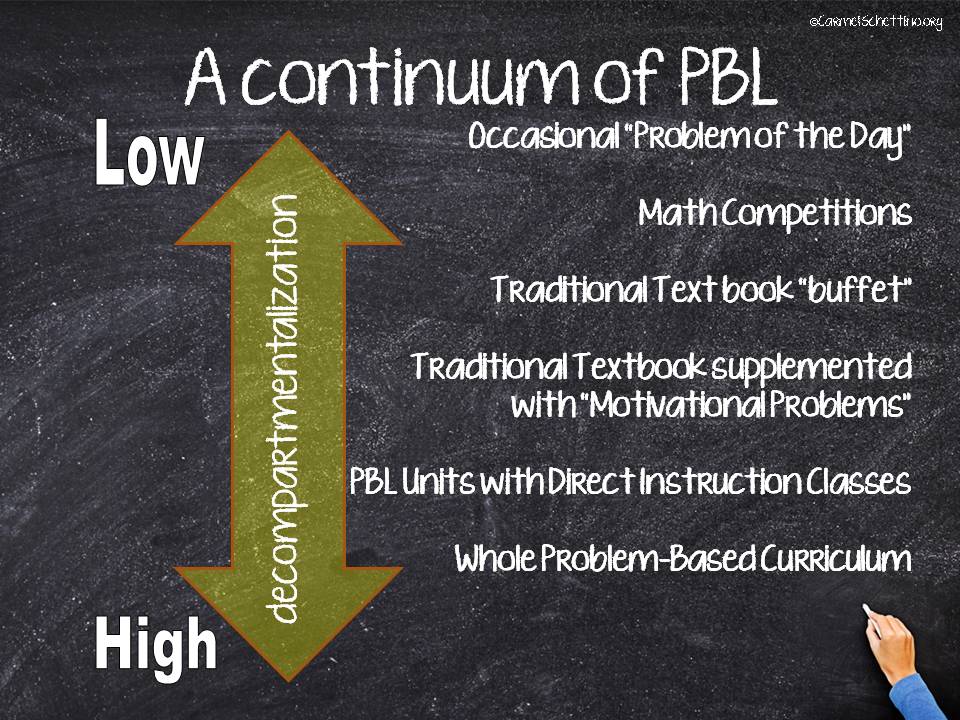
I talk about the Continuum of PBL when I give workshops to let people know that you don’t have to dive in head first if you want to try your hand at classroom discourse a little at a time.  Learning to facilitate discussion as a long-time direct instruction teacher is actually quite difficult to allowing students to have more authority can be tricky.  Here is the visual aid that I use when I discuss it:

“A Continuum of PBL” cschettino 2013

The arrow tells you the level of decompartmentalization of topics – in other words how the topics are blended together or not.  In a traditional mathematics curriculum, a textbook artificially separates mathematics into what I like to think of a “compartments” that in a very linear order and most students learn to believe that mathematics must be taught in that order.  Yes, some operations and skills must come before others, but conceptually a great deal of mathematics can be learned or thought about in no particular order.  It is all extremely and equally fascinating.  In a whole problem-based curriculum such as what the faculty at Phillips Exeter Academy has written there are no chapters that mark the ending of the content and the beginning of another since there truly no time when that content is no longer applicable to the new material that is being learned (yes, of course that is true in a text book as well, but the chapter alone have come to imply that to students).

Decompartmentalization can come at different levels.  At the lowest level,many  teachers use “Problems of the Day” that challenge students at the beginning of class with logic puzzles, topics they are not seeing regularly or interesting tidbits like soduku or other fun activities to get students’ minds working.  These create discussion and allow them to see problem solving in action.  However, there is little connection to the mathematics that is being learned in the class proper.

I won’t discuss every type of PBL on the continuum or this will turn into one of my hour long talks, but I will say that if you are interested in attempting to keep up with your colleagues who are following a traditional syllabus but you might want to use less direct instruction I have a link to my “Motivational Problems” page in order for you to have them start the conversation based on their prior knowledge of material.  The problems are listed by topic and you can have them move forward in class by presenting problems and then have them practice with problems in the textbook.  Anyone who tries this – I’d love to hear from you!

This was how I first started at my last school and it worked well for me.  You can read my article from 2003 in the Mathematics Teacher to learn what it was like.  But it definitely moved me in the right direction.  Keep pushing on!

An infinite amount of thanks…

Everyone has those mentors in their life who have impacted their work or career in ways that have truly changed who they are.  In my instance, the person I am going to write about not only has impacted my life and career, but because he taught me so much about great teaching, in particular PBL, he has impacted all of the students and teachers I have worked over my twenty year career so far.  So I feel justified in taking a short break from writing strictly about professional educational work musings and just finding a moment to say thanks for the life and work of Rick Parris.

Even if you never met Rick in his time teaching at Phillips Exeter Academy, or used his wonderful opensource Peanut software for windows machines, or downloaded the faculty-authored materials that he was integral in writing by the mathematics department at PEA – if you have worked with me at all, you have been affected by Rick’s work.  Rick Parris had to be one of the most brilliant, efficient, insightful  mathematicians I’ve ever been lucky enough to work with.  He saw things in a problem that I definitely never would be able to see in a million years.  I was so extremely intimidated by him when I first started working in the same department that I would go for days confused about a problem instead of go up and ask him.  But what I soon found was that not only was he one of the most brilliant mathematicians, I’ve ever met, but he was one of the best teachers too.  Now, there is a rare combination – finding someone who has the insightful intelligence to be able to have a Ph.D. in mathematics but to also be so sensitive to others’ understanding of the subject and the patience and passion to want them to love it as much as he did.

I remember finally having the courage to go and ask him a question about a problem in the 41C materials on fall afternoon (mostly because I knew I had to understand it) and he looked at me, with what I thought was a look of disdain or horror that one of his colleagues wouldn’t understand a problem that he wrote.  And just as I was going to run in shame, he said something like, “that is such an interesting way to look at that” and I was amazed at how good that felt.  He entertained my ideas and although I felt like he was initially just appeasing me, I soon realized that he was truly and sincerely intrigued.  Our relationship as colleagues and interested problem solvers grew, even after I left PEA.  He allowed me to keep in touch constantly asking him questions and posing them over email.  He taught me so much about writing great problems, encouraging students to ask great questions and making sure that they always felt like they were they most interesting questions ever.

This past summer, the last time I saw Rick, we were talking about the game of Set (you know that really fun card game with the colors, shapes and numbers).  We were just posing really fun questions like “What’s the maximum number of sets you can get in a 12 card deal?”  We found these types of questions intriguing and even after we parted company we continued emailing with email subject lines like “a baker’s dozen of sets”, “set lore” and “the game of set redux.”  He always treated me like a real mathematician even though he was the one who I saw as my inspiration and motivation in that area.

Rick taught me about how to scaffold problems (not too much) so that students would see their way through a topic and find out exciting ideas of mathematics on their own.  I loved to watch him teach, probably observing his classes three or four times a year in order to gain insight into his questioning methods.  He made a point of trying to hear from every student in the class at least once a class.  I don’t know if he ever knew how much of an impact he had on my teaching and philosophy of learning.  I am so grateful.

So how do you say thank you to someone who pushed you in a direction that changed your life?  I guess I have just to recommit myself to learning about and researching the best practices of inquiry and problem-based learning in secondary mathematics education.  I do believe that the world needs to know about the contributions of this man and the department at PEA because without them and the model that they have created, I’m not sure that many of the schools today that utilize their curriculum would be where they are.  I give thanks to Rick and consider myself extremely lucky to have worked with him and shared his enthusiasm for problems.

Documents for Anja S. Greer CwiC sessions

I’ve decided to post the presentation slides and handouts for the CwiC sessions that I’m giving at the Exeter Conference here.

Here is the handout for my CwiC Session entitled iPad Apps for the Mathematics Classroom:
handout .

Here are the presentation slides for the same CwiC Session:
Slides .

Here are the presentation slides for the Calculus of Friendship quick session: (the one with the solutions will be up after the conference)
Slides .

Here are the presentation slides for the session on Teaching STEM for Girls:
Slides .

Boston College Discrete Math Conference

Thanks to everyone who attended my presentation today at the Boston College Discrete Math Conference. For those of you who wanted presentation slides, here they are .

Thanks to the participant who helped edit my error on the matrix worksheet. Here are the problems that we discussed and some motivational problems. Enjoy!
Discussion problems from the slides
Motivational Problems on Matrices
Motivational Problems on Apportionment

If you are interested in the PBL Geometry curriculum I spoke about, look for it under In the Classroom->Teaching in the menu above.

Thanks for a great week!

Thanks to everyone who was in my PBL class this week. I had a wonderful time at the Anja S. Greer PEA Math Conference and met lots of wonderful people. For those of you in my week-long class, please feel free to fill out the course evaluation at:

Schettino Course Evaluation

So many teachers that I’ve met were extremely inspiring – As usual I learned so much from everyone about new ways to view technology, certain types of curriculum, ways to incorporate different topics in the classroom and even how to do a Rubik’s cube. I appreciate this converence so much and keep coming back every year. Thanks again to everyone. Special thank you goes out to Ron Lancaster for his special gift of the DVD movie version of The Housekeeper and the Professor which is a wonderful story of relationship through mathematics and creativity. I highly recommend it. Thanks so much Ron!

Many thanks

I have returned from my trip to Indianapolis and I would like to thank everyone that I met there for turning out to both of the presentations that I gave. The talk I gave on Saturday, which was with my colleague was more about our Problem-Based Learning curriculum at our school. The turn-out there was amazing and we were so impressed with the questions and comments from the group. Some of the feedback was great food for thought, especially some specific questions about our definition of PBL. It was also extremely useful to hear what teachers would feel are the challenges of implementing PBL in the classroom. I would direct some teachers to the blog of a teacher in Massachusetts named Mark Vasicek who has attempted to you PBL pretty consistently for a number of years West Side Geometry. It’s good reading.

I think that one of the reasons that so many people might be interested in even thinking about changing the way that they teach right not is because of recent work through the CCSS. There were so many opportunities at this conference to read about, talk about and learn about the details of the Common Core State Standards that I think by Saturday many people were almost tired of hearing about them. However, PBL definitely directly relates to at least a few of the CCSS standards of Mathematical Practice:

Making sense of problems and persevering in solving them.
Reasoning abstractly and quantitatively.
Constructing arguments and critiquing the reasoning of others.
Looking for and expressing the patterns used in reasoning.

We tried to give examples of how we see these standards coming to life as outcomes in student work on a regular basis in the PBL classroom. Having so many people come up to us afterwards for more information, or with interest in getting in touch was really exciting. Sunshine and I truly hope that you do. I really look forward to it.

First Day at Indy

What a great day at the NCTM national conference in Indianapolis. My colleague and I arrived late last night so I missed registration. However, since my talk was today at 9:30 am, I was supposed to be registered at least two hours before I was supposed to speak, so I needed to be up pretty early to get there to register in the exhibit hall. That was not a problem since I was so excited that I was up at 5:30 anyway. After registering, I went to a presentation of orchestrating successful class discussions in the math classroom which seas geared towards elementary and middle school teachers. This was very interesting because most of what I have read has been about secondary level reaching. It was interesting to sees the framework that they used and how important it was to try to anticipate what you. Thought students would say. Many of the ideas they shared were very similar to what I would have said.

I showed up to my room about 15 minutes early and people started coming in. I was very excited that there was interest in my topic. Because this one was a research session I had not planned many interactive activities because I had so much information to share. However, I encouraged people to be a part of the conversation. I think it went very well because many people shared thoughts during the talk and also stayed afterwards. I ran out of handouts and am hoping that those people with questions will contact me and we can keep the conversation going.

I got some great input from some members of the audience that I think will really help me improve my article. One fellow graduate student told me that he thought I would have a stronger argument for the self-referencing pronoun use being a positive sign of empowerment in the discourse if I used a chi-squared test inn the data I had instead of just looking at it qualitatively. Another preservice teacher told me that I should tr to make a distinction between social norms in the use of the pronouns and sociomathematical norms. I think this is a good point and something that I need to look into more in the current research.

Overall, this first talk was a great experience and I’m so glad it was so well received by those who participated. Hopefully, tomorrow will be just as fun and we’ll get some good responses from the crowd. Thanks to everyone that attended.